
When I was young, I wanted to be an astronaut.
I'd stare at the night sky and imagine each bright point as another world. Not a ball of plasma, not a distant sun. A place. Somewhere out there, I pictured a kid sitting at a kitchen table, late for school, while their parents argued in a language I would never understand.
I wondered what their homes looked like. I imagined cities hanging upside down from clouds. Or little bedrooms carved into the sides of mountains. I could never decide whether the aliens would be gentle enough to wave back or so large they would not notice us at all.
Mostly, I wondered when we would meet them.
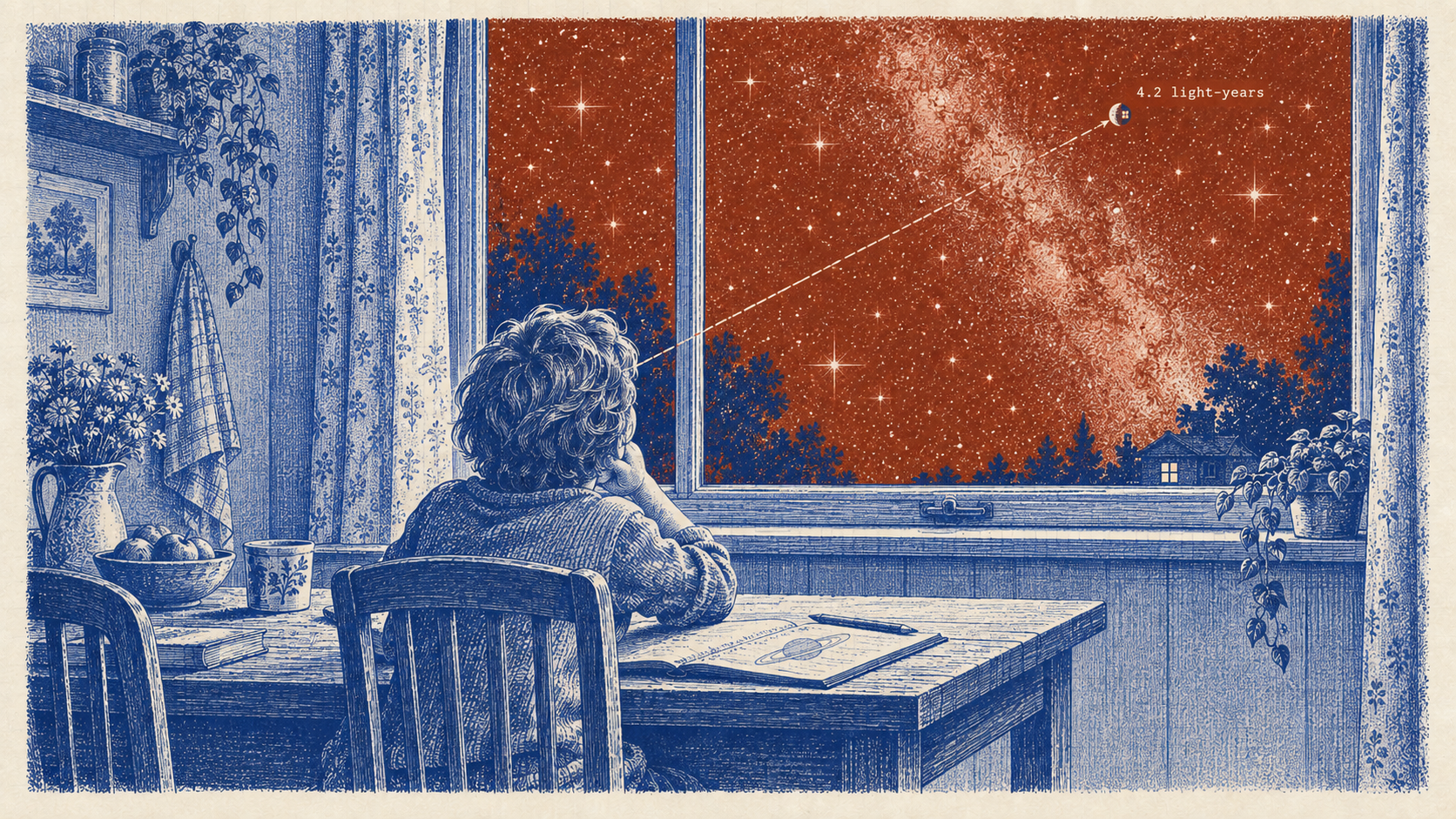
Then I learned what the bright points actually were.
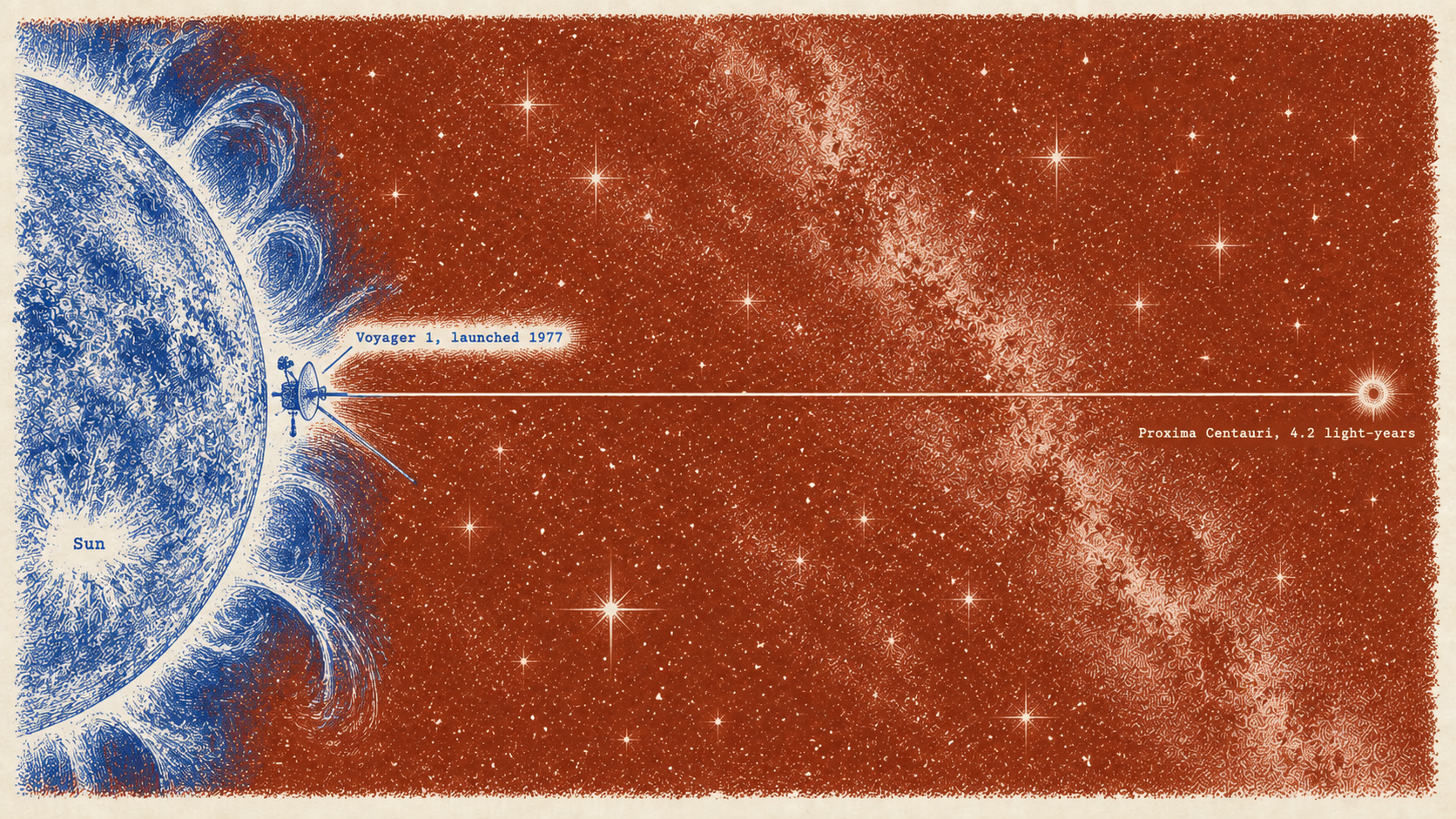
Most of them were not nearby worlds at all. They were stars. The closest is about four light-years away, far enough that Voyager 1 would need some 75,000 years to reach it.
As a child, I assumed meeting them was only a matter of time.
Finding other worlds turned out to be the easy part. Astronomers have now confirmed more than 6,000 planets around other stars. The hard part is reaching any of them, and then staying alive once we arrive.
Space is stranger than most of us think. Almost nothing about it resembles the conditions our bodies were built for, and that is what makes surviving there so hard. It is also why so much current research, from rocket materials to closed-loop life support, comes down to the same task. Carrying enough of Earth with us.
Still Earth
Humans like to think of ourselves as adaptable, and we are. But every test of that adaptability has been held on the same planet.
Bragging about it is like giving a kid a trophy because his mom drove him to the game.
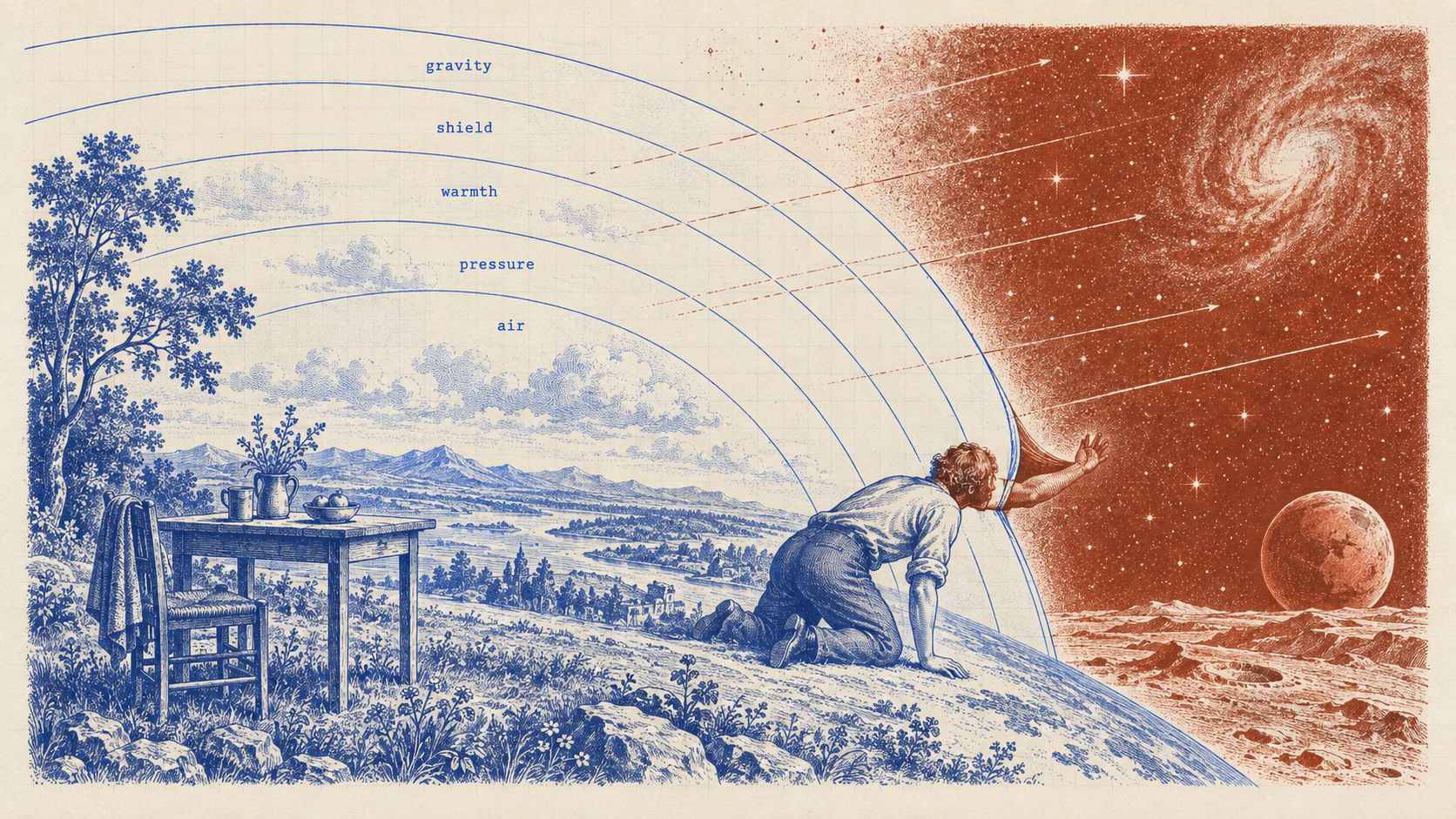
Antarctica has reached −89°C (−128°F), but it is still Earth. The summit of Everest has a third of the air pressure found at sea level, but it is still Earth. Even a submarine at depth is inside a planet whose gravity, air, warmth and shielding already made human life possible.
Space is different because it removes that planet, and nothing within reach replaces it.
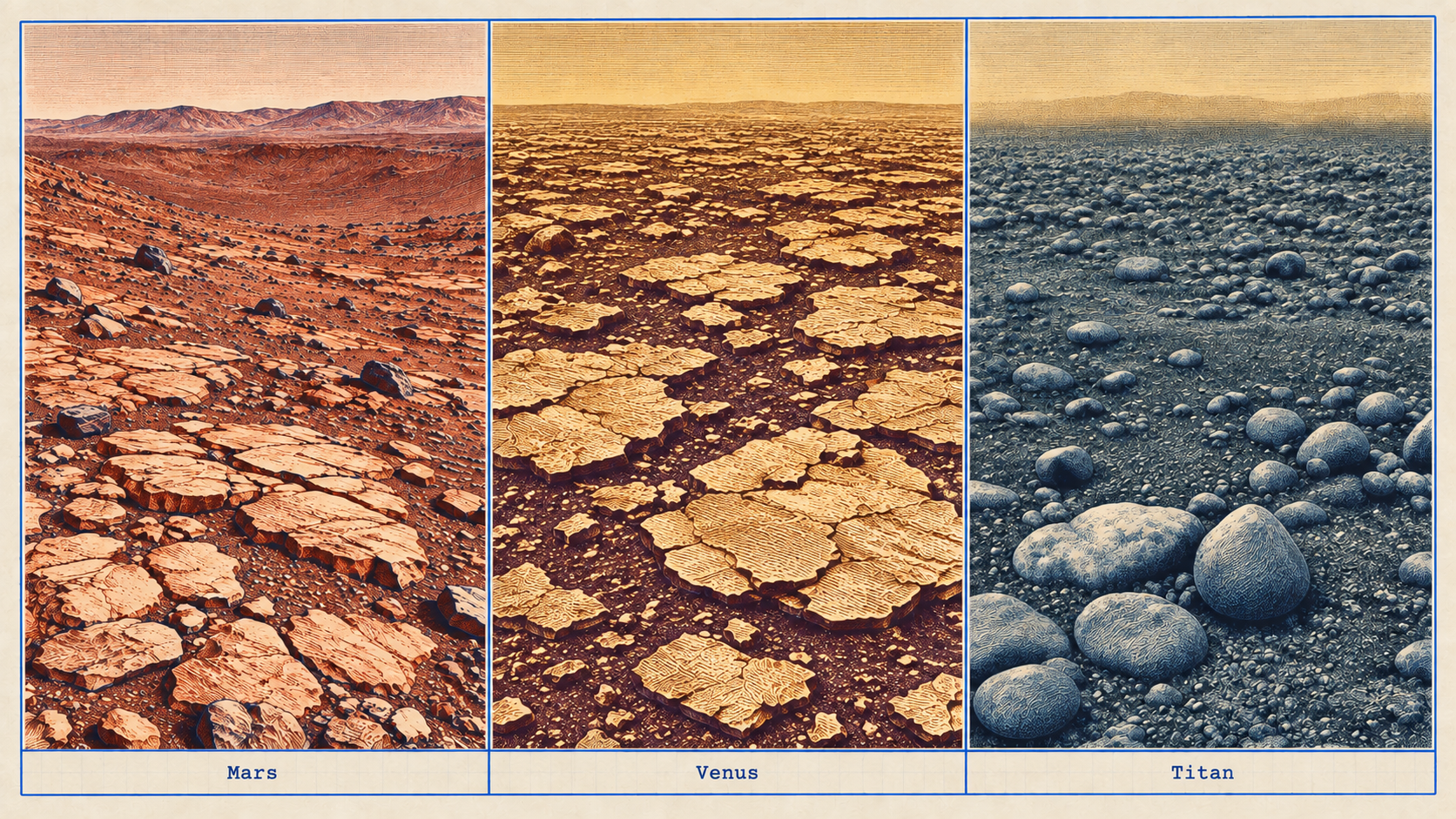
Mars can have t-shirt weather on a summer afternoon, in air too thin to breathe, and then fall below −70°C (−94°F) the same night. The surface of Venus is hot enough to melt lead. Titan’s rivers and seas are made of methane, not water.
Our bodies, and nearly everything we build, assume Earth is there. I think of this as the Earth assumption, and on Earth it is never tested.
To ask why space is hard is to ask what human life requires once Earth is no longer supplying the conditions for it.
A year without Earth
The cleanest test of that assumption so far involved a pair of identical twins.
NASA’s Twins Study followed astronaut Scott Kelly before, during, and after 340 days aboard the International Space Station. His identical twin brother, Mark, stayed on Earth. That gave researchers a rare comparison.
Two people with nearly the same DNA. One in orbit. One at home.
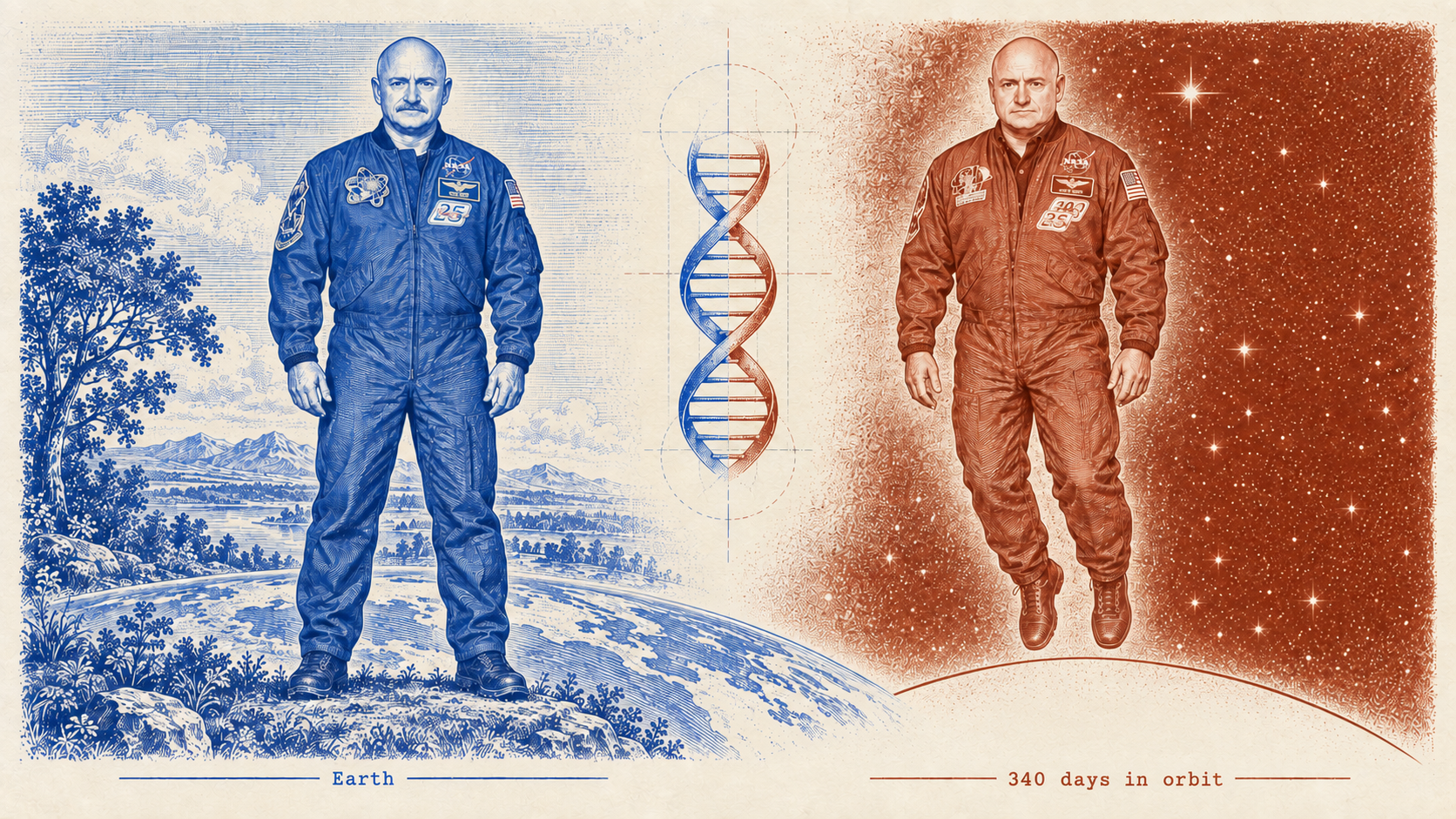
The study found that a year in orbit changed Scott’s body at almost every level researchers checked. The changes ran from his chromosomes to his scores on tests of memory and attention. Most of those changes reversed within months of landing. A few did not. He was still Scott, but his body had clearly noticed that it was no longer on Earth.
One signal came from his telomeres. These are the protective caps at the ends of chromosomes, and they help keep genetic material stable when cells divide. They tend to shorten with age and stress, so researchers expected a year in space to wear them down.
Instead, Scott’s got longer.
Then, within two days of his return, most of them shortened again. He ended up with more short telomeres than he had before the flight. Longer was not simply good, and shorter was not simply bad. Orbit had changed something as basic as how his cells maintain their chromosomes.
Gene activity changed too. Every cell carries the same DNA, but cells constantly turn individual genes up or down depending on what is happening around them. This is called gene expression, and in orbit Scott’s shifted. Some of the changes involved how his body handled stress. Others involved the systems that repair DNA, regulate immunity, and maintain bone.
Early headlines got this wrong and announced that 7 percent of Scott’s DNA had changed. It had not. Humans and chimpanzees differ by about 1 percent, so a 7 percent change would have brought him home as a different species.
What actually changed was gene expression. After landing, 93 percent of those changes returned to normal. The remaining 7 percent had not returned to baseline six months later. Spaceflight did not need to rewrite his genetic code to change how his body worked.
Mentally, Scott held up well in orbit. On tests of memory, attention and reaction time, he performed about as well on the station as Mark did on the ground. The drop came after landing. His speed and accuracy fell and stayed down for months. Readjusting to gravity seems to take a toll on the mind as well as the body.
On Earth, that is manageable. A recovery team carries you out of the capsule, and nobody asks you to do anything difficult for a while.
A crew arriving on Mars would get no such welcome. They would land after months in space, at their least sharp, with all the work still ahead of them.
None of this broke him.
Scott Kelly came home and recovered most of what he had lost. But he is one man, and he was gone for one year. The whole time, a capsule was docked outside that could have had him back on the ground within hours.
The question is not whether humans can get by without Earth for a while. We can, with enough machinery and support. The harder question is what happens when that stops being a mission and becomes a way of life. People would have to stay healthy for decades, raise children, and keep the machines running.
How much gravity does a human need?
Start with gravity. On Earth, your body pushes against it all day without you noticing, and that constant effort is what keeps it strong.
Bone needs load. On Earth, every step tells the skeleton it is still worth maintaining. In orbit, that signal goes quiet, and the body starts breaking down bone it no longer seems to need. Astronauts’ hips, spines and legs lose 1 to 1.5 percent of their mineral density every month. That is roughly what an older person on Earth loses in a year.
Muscle gets the same message. On Earth, standing is exercise. Your legs, back, and core are quietly fighting gravity all day. In orbit, that job disappears. Station crews exercise for about two hours a day, trying to replace work the planet used to assign automatically.
Gravity also decides where your blood goes.
On Earth, it pulls blood and other fluids down toward the legs. In orbit, nothing does, and they drift toward the head. Faces swell. Legs shrink. Astronauts call it puffy face and bird legs.
It sounds funny until it reaches the eyes. Pressure builds behind them, and in about 70 percent of station astronauts the back of the eye swells or flattens. Some come home needing stronger glasses. NASA calls this spaceflight associated neuro-ocular syndrome, or SANS.
Nothing is wrong with the eyes themselves. The plumbing around them was built for gravity. And a small blur matters when the thing in front of you is a docking port, a warning light, or the edge of a torn glove.
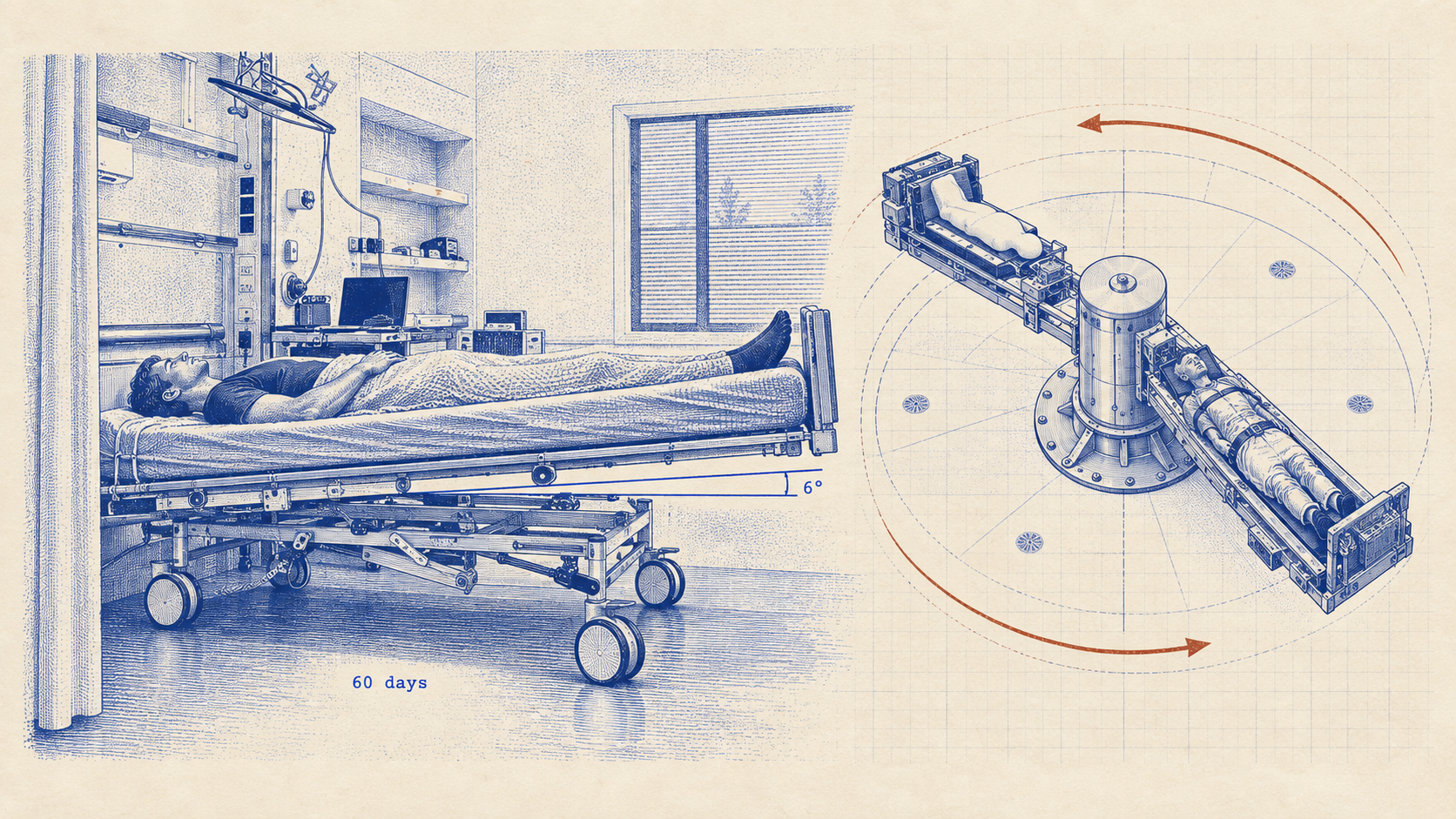
Researchers are testing whether gravity can be put back. In 2019, ESA, NASA and the German space agency DLR had 24 volunteers lie in bed for 60 days with their heads tilted six degrees below their feet. That mimics the fluid shift of orbit. Some of them were also spun in a short centrifuge once a day. The question was whether a daily dose of artificial gravity could hold off the damage.
But every astronaut so far has been an adult who grew up on Earth. Nobody has ever grown up anywhere else. How much gravity does it take to build a healthy human body, from conception through childhood and into old age?
We do not know.
Nearly everything we know comes from two settings, the full gravity of Earth and the near-zero of orbit. The only people who have lived anywhere in between are the twelve Apollo astronauts who walked on the Moon. None of them stayed longer than about three days.
Mars has about 38 percent of Earth’s gravity. That number is easy to remember and hard to interpret. Could a pregnancy develop normally there? Could a child build an Earth-strength skeleton? Could a Martian-born adult return to Earth without being medically disabled by the body they grew into? These questions sit at the center of any serious claim about permanent settlement.
A base can be staffed by rotating crews. A civilization cannot.
If children cannot develop normally in partial gravity, a settlement has three options. It can spin its habitats, re-engineer its people, or keep importing adults from Earth.
The strange part is how fast the change could come. Evolution needs thousands of generations. This would happen over one. A child raised on Mars would have the same kind of genes as her cousins on Earth. But her bones, muscles and heart would be built for a third of the weight.
She would be fully human, and she might never be able to stand on the planet her grandparents came from.
Air can be bottled and water can be recycled. Gravity can only be faked by spinning, and no spinning habitat has ever been built.
The weight of air
In 1644 the Italian physicist Evangelista Torricelli wrote that we live at the bottom of an ocean of air. It is heavier than it looks. At sea level, air presses on every square centimeter of you with about a kilogram of force. You never feel it, because your body pushes back just as hard. It was built under that pressure and expects it.
Your lungs expect it too. They do not pull oxygen in. The pressure of the air pushes it across into your blood. That is why climbers struggle on Everest. The air up there has the same 21 percent oxygen as the air at the beach. With only a third of the pressure behind it, not enough gets through.
Take the pressure away entirely and the movies get it wrong. You do not explode, and you do not freeze solid.
In 1966 a NASA technician named Jim LeBlanc was testing a suit in a vacuum chamber in Houston when his air hose popped off. He stayed conscious for about 14 seconds. The last thing he remembered was the saliva on his tongue starting to boil. With no pressure to hold it liquid, water boils at body temperature.
The chamber was repressurized, he woke up, and he went home with an earache.
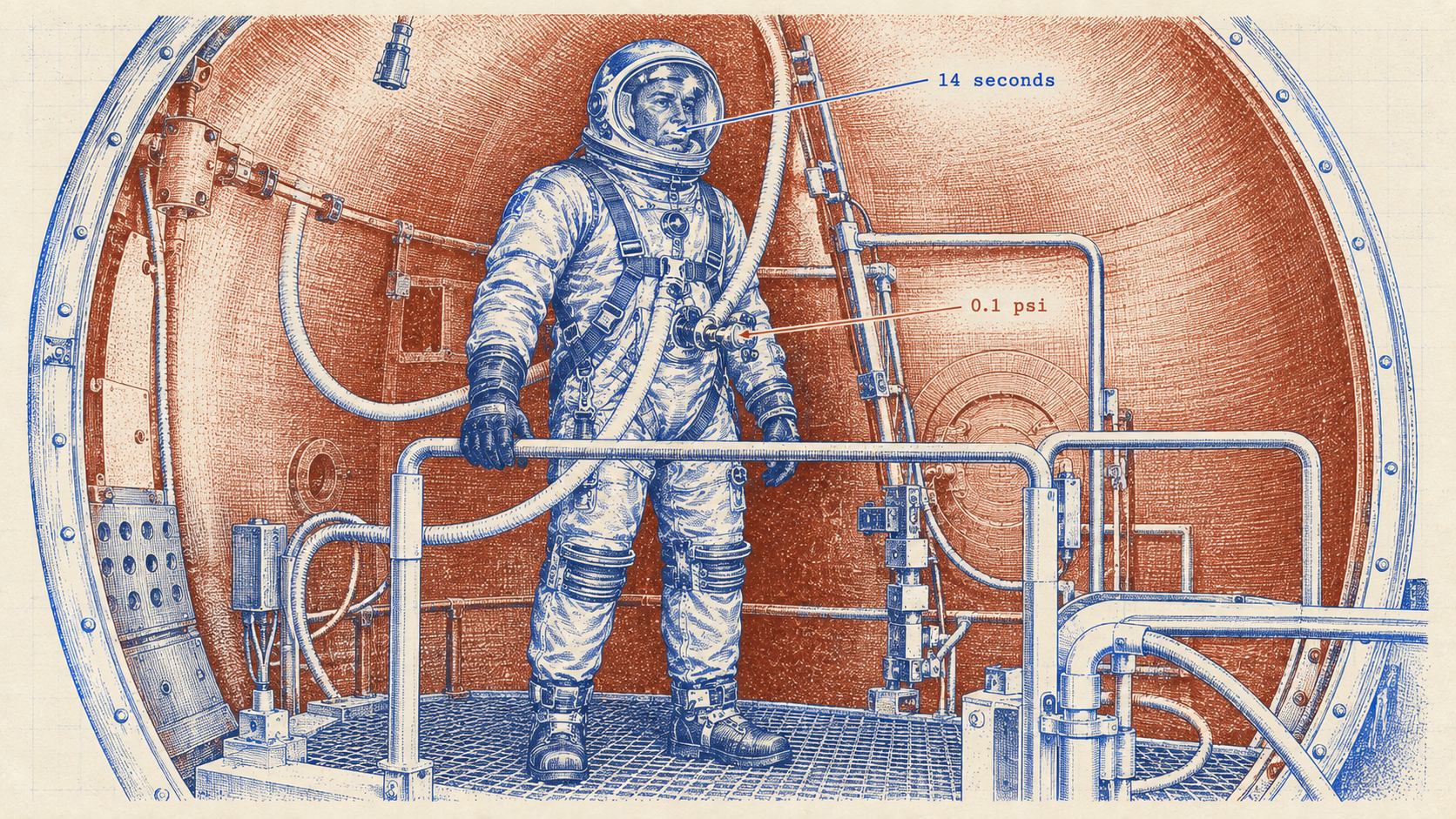
A spacesuit is really a small spacecraft shaped like a person, and pressure is the hard part. Inflate a suit to sea-level pressure and it goes as stiff as a car tire. So NASA’s suits run at less than a third of that, filled with pure oxygen to make up the difference.
That solves one problem and causes another.
Dropping to low pressure too fast gives astronauts the bends, like a diver surfacing too quickly. They spend hours breathing pure oxygen before a spacewalk to prevent it. Even then, every squeeze of the hand fights the glove. In one study of 232 astronauts, about one in ten had injured fingernails, and some had lost nails entirely.
Other planets do not solve this. Mars has air, but less than one percent as much as Earth. That is so little that an oxygen mask would not save you. You would still need the pressure suit. Venus has the opposite problem. The pressure at its surface is about what you would feel a kilometer under the ocean. Having an atmosphere and having a usable one are different things.
On Earth, the air does this work so quietly that we forget it is doing anything at all.
Nowhere for the heat to go
Air has a second job that is just as easy to miss. It moves heat around.
People describe space as cold, and that is only half right. On Earth, you get cold because the air or water touching your skin carries your heat away. In space, nothing is touching you. A vacuum is the best insulator there is, which is why a thermos has one built into its walls. The only way to lose heat in space is to glow it away as infrared light, and that is slow.
So the real problem is that nothing evens the temperature out. At the Moon’s equator the ground reaches 121°C (250°F) in daylight and falls to −133°C (−208°F) at night. The night lasts two weeks. Apollo crews dealt with the same problem by slowly rotating their spacecraft all the way to the Moon so that no side cooked.
They called it barbecue mode.
For anything with people or electronics inside, overheating is usually the bigger danger. Everything on board makes heat, and there is no breeze to take it away.
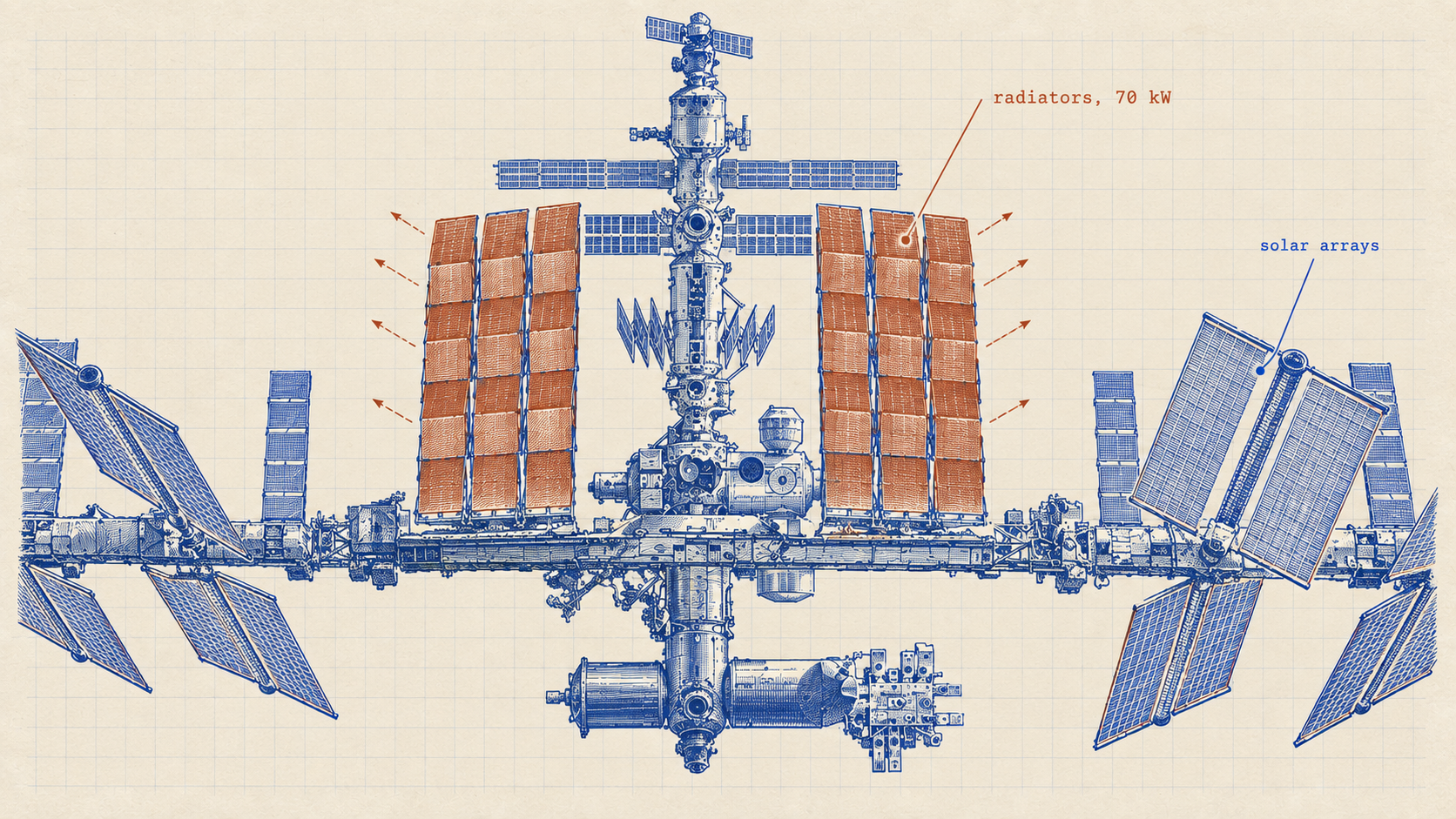
Some of the big panels on the space station are radiators rather than solar arrays. They work like the radiator in a car. Liquid ammonia is pumped through pipes inside the station, where it soaks up heat. Then it flows out through the panels, which glow that heat away into space. Together they shed about 70 kilowatts, roughly what fifty electric kettles give off.
A spacesuit has the same problem on a smaller scale. An astronaut working hard inside a sealed, insulated suit would quickly overheat. So under the suit they wear long underwear threaded with about 90 meters of tubing, with cold water running through it the whole time. Astronauts call it the spaghetti suit.
Get the balance wrong in the other direction and it goes just as fast. When Apollo 13 lost power, the crew shut down nearly everything to save the batteries. The cabin fell to 3°C (38°F), because the electronics had been the heater all along.
On Earth, air and water spread the heat around, and we call the result weather. In space, every degree has to be moved by a machine.
The shield overhead
Radiation may be the clearest Earth assumption of all.
It is energy on the move. The dangerous kind carries enough punch to break the molecules it passes through. On Earth that mostly means X-rays. In space it means atomic particles moving at enormous speeds. When one of them breaks a strand of DNA, the cell has to repair it. Usually it does. Sometimes it gets the repair wrong, and that is how radiation leads to cancer.
On the ground, most of us only run into it as an X-ray at the dentist or a warning sign on a door. We can afford to, because the planet does the shielding for us. Earth’s magnetic field turns away most of the charged particles streaming from the Sun. The atmosphere soaks up much of what is left. Remember the kilogram of air pressing on every square centimeter of you? It also shields you as well as ten meters of water would.
Leave that shelter and there are two things to worry about. The first is cosmic rays. These are atomic nuclei flung out by distant exploding stars at close to the speed of light. They arrive all the time, from every direction. They pass through a spacecraft hull as if it were barely there. Apollo astronauts could literally see them. With their eyes closed, they noticed flashes of light every few minutes. Each one was a particle passing through the eye.
The second is solar storms. They are rare, but a big one can deliver a dangerous dose within hours. In August 1972 one of the largest of the space age erupted. It fell between Apollo 16, which had come home in April, and Apollo 17, which left in December. Astronauts on the Moon that week could have come down with radiation sickness, or worse.
Nobody was there, and that was luck.
The slow dose adds up too. When the Curiosity rover flew to Mars, a detector inside the spacecraft kept count the whole way. The exposure was like getting a whole-body CT scan every five or six days. Over a round trip, that adds up to about 200 years’ worth of the natural radiation you would absorb living on Earth.
It is also more than NASA allows an astronaut in an entire career.
You would think the answer is thicker walls. It mostly isn’t. When a cosmic ray slams into a metal wall, it does not just stop. It smashes atoms in the metal and sends a shower of fragments into the cabin. So a hull too thin to stop the ray can leave the crew with a bigger dose, not a smaller one.
What works better is anything with a lot of hydrogen in it. Hydrogen is the smallest atom there is, so when a cosmic ray hits it, there is almost nothing to break into fragments. In practice that means water and plastic. The sleeping quarters on the space station are lined with blocks of polyethylene, the plastic milk jugs are made of.
Most of the research is about getting that protection without the weight. At Brookhaven National Laboratory in New York, the NASA Space Radiation Laboratory fires beams of heavy atoms at cells, electronics and new materials to see what holds up. NASA’s Langley center is developing nanotubes of boron and nitrogen that can be loaded with hydrogen. The hope is a material strong enough to be the hull and the shield at the same time, so a ship would not have to carry both.
For solar storms, something simpler may do.
In 2022 two mannequins named Helga and Zohar flew around the Moon on Artemis I. Zohar wore a radiation vest and Helga did not. Results published in 2026 found the vest would have cut the dose from a storm like August 1972 by about 60 percent.
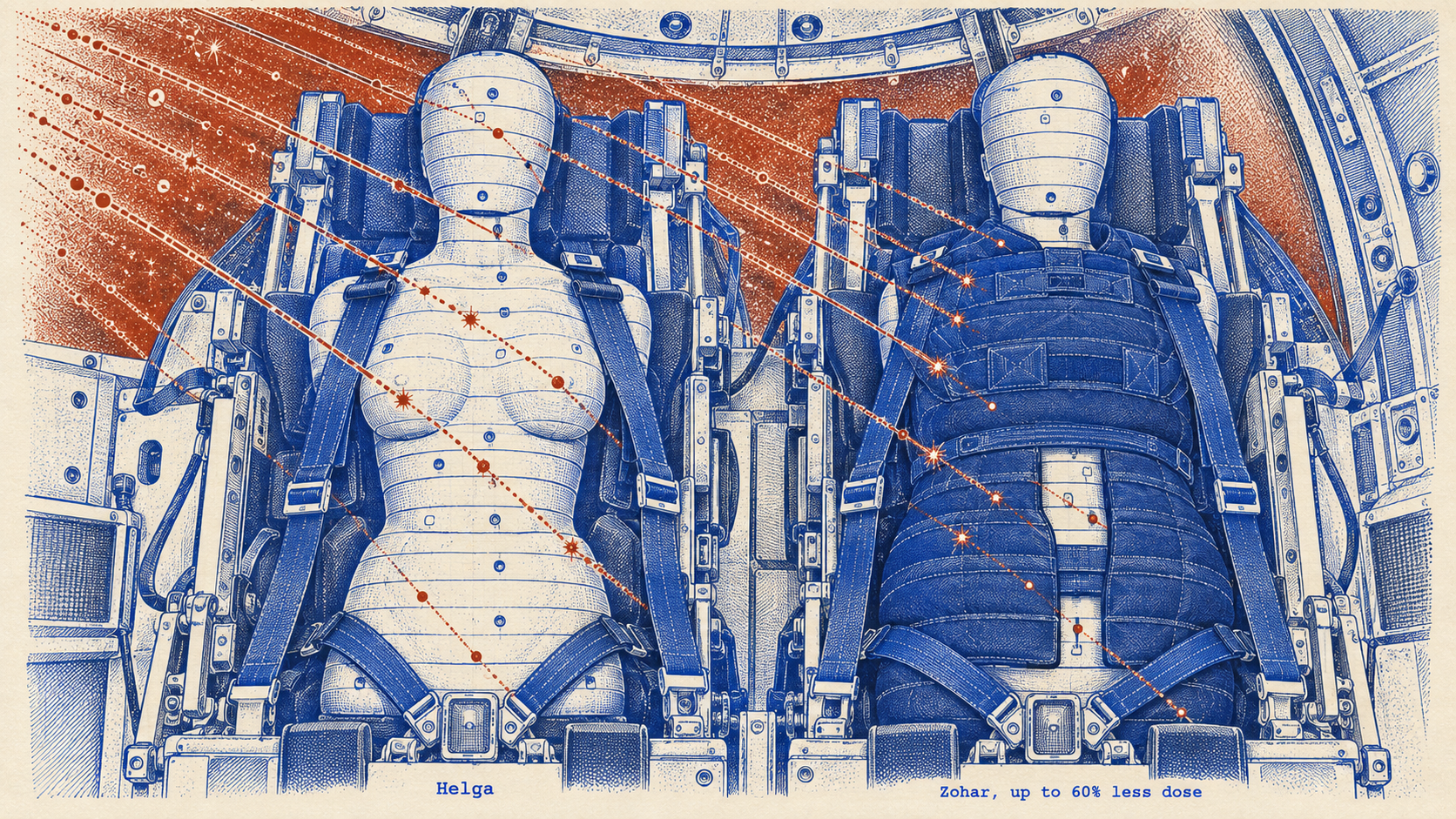
Cosmic rays are the unsolved part. Any wall thick enough to stop them would be too heavy to launch. There are bigger ideas, like giving a ship its own magnetic field, the way Earth has one. So far nobody has built one.
For now, the most reliable shield is a shorter trip.
On the Moon and Mars, the cheapest shield is the ground. A few meters of soil overhead does the job. The first settlers may well live in buried habitats or caves. For a visiting crew, radiation mostly means a higher risk of cancer later in life. For a settlement that wants children, it matters more. Eggs, sperm and embryos are among the most radiation-sensitive things in the body.
We evolved under two shields and never had to think about either. Anywhere else, someone has to build them.
Everything has to be lifted
Look back at the fixes so far. Spinning habitats. Walls of water and plastic. Radiators, pressure suits, bottled air. Every one of them is heavy, and every kilogram has to get off the Earth first.
That is harder than it looks, and the reason surprises most people. Space is not far away. It starts about 100 kilometers up, which would be an hour’s drive if your car could go straight up.
The hard part is staying there.
To stay in orbit, a spacecraft has to move sideways at about 7.8 kilometers per second. That is fast enough to cross the United States in ten minutes. At that speed it is still falling, the whole time. It is just moving sideways so fast that it keeps missing the ground.
Getting up to that speed is where the trouble starts. A rocket speeds up by throwing mass out the back. To go faster, it needs more fuel. But fuel is heavy. So the rocket needs extra fuel just to lift the fuel it already has. That extra fuel is heavy too, so it needs even more to lift that. The pile keeps growing. Engineers call this the rocket equation. The astronaut Don Pettit calls it a tyranny.
Speed comes from throwing mass away, and that mass must first be lifted.
The result is that a rocket on the launch pad is 85 to 90 percent fuel by weight. The Saturn V that sent Apollo to the Moon weighed about 3,000 tonnes at liftoff. The capsule that brought the crew home weighed under six.
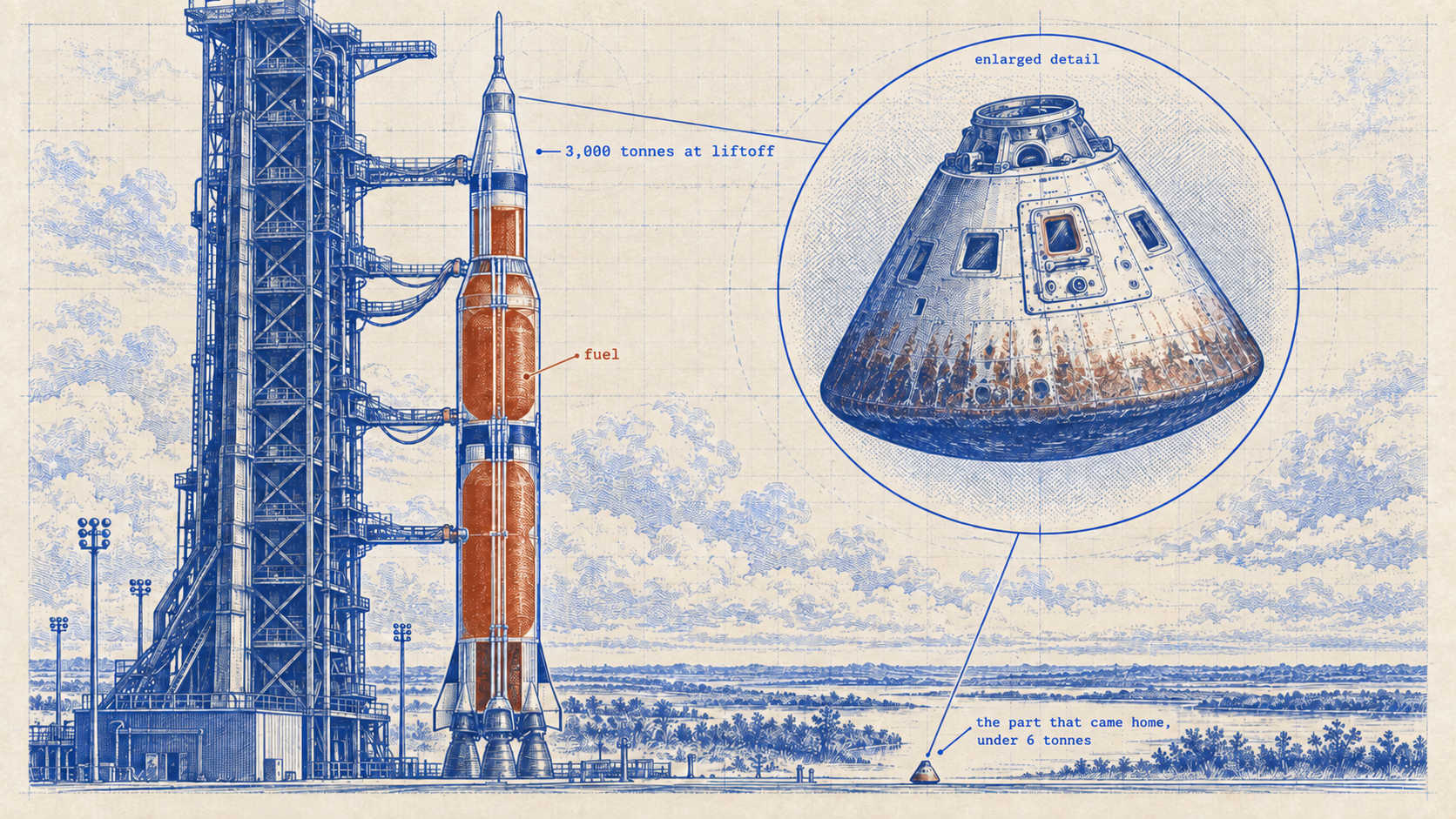
For most of the space age, all of that hardware was thrown away after a single flight. Landing rockets and flying them again changed the price. The Space Shuttle cost about $54,500 for every kilogram it put in orbit. A Falcon 9 costs about $2,700.
The next step is refueling in orbit. A ship that can top up its tanks after launch does not have to leave the ground carrying fuel for the whole trip. NASA’s plan for landing on the Moon again depends on it.
The step after that is to stop lifting things at all. Water, oxygen or fuel made on the Moon or Mars never has to fight Earth’s gravity. That is the difference between shipping a civilization into space and growing one there.
A controlled explosion
The rocket equation leaves engineers two ways to fight back. They can get more push out of every kilogram of fuel. Or they can make everything that is not fuel weigh less. Most of the work on rockets today is one or the other.
Start with the fuel, because fuel is not just fuel. There are three main choices, and each has a catch.
Hydrogen gives the most push per kilogram. But it has to be kept at −253°C, and its molecules are so small that they leak through seals that would hold anything else. Kerosene is cheap and easy to store. But it burns dirty and leaves soot inside the engine, which is a problem if you want to fly that engine again. Methane sits in between. It burns clean, and it is easier to store than hydrogen. It also has one advantage the others do not.
You can make it on Mars.
Mars’s air is carbon dioxide, and there is water ice in its soil. Combine the two with some electricity and you get methane and oxygen. That is rocket fuel, plus the oxygen to burn it with. It is why most big new rockets, including SpaceX’s Starship, run on methane.
Then there is the engine, which has the worst job on the vehicle. Inside the chamber where the fuel burns, the gas reaches about 3,300°C. The copper walls of that chamber melt at about 1,100°C.
The fire is three times hotter than the melting point of the engine around it.
It survives because of a trick. Before the fuel is burned, it is pumped through hundreds of tiny channels inside the chamber wall. The fuel is freezing cold, so it carries the heat away. The engine is cooled by its own fuel, right up to the moment that fuel is set on fire.
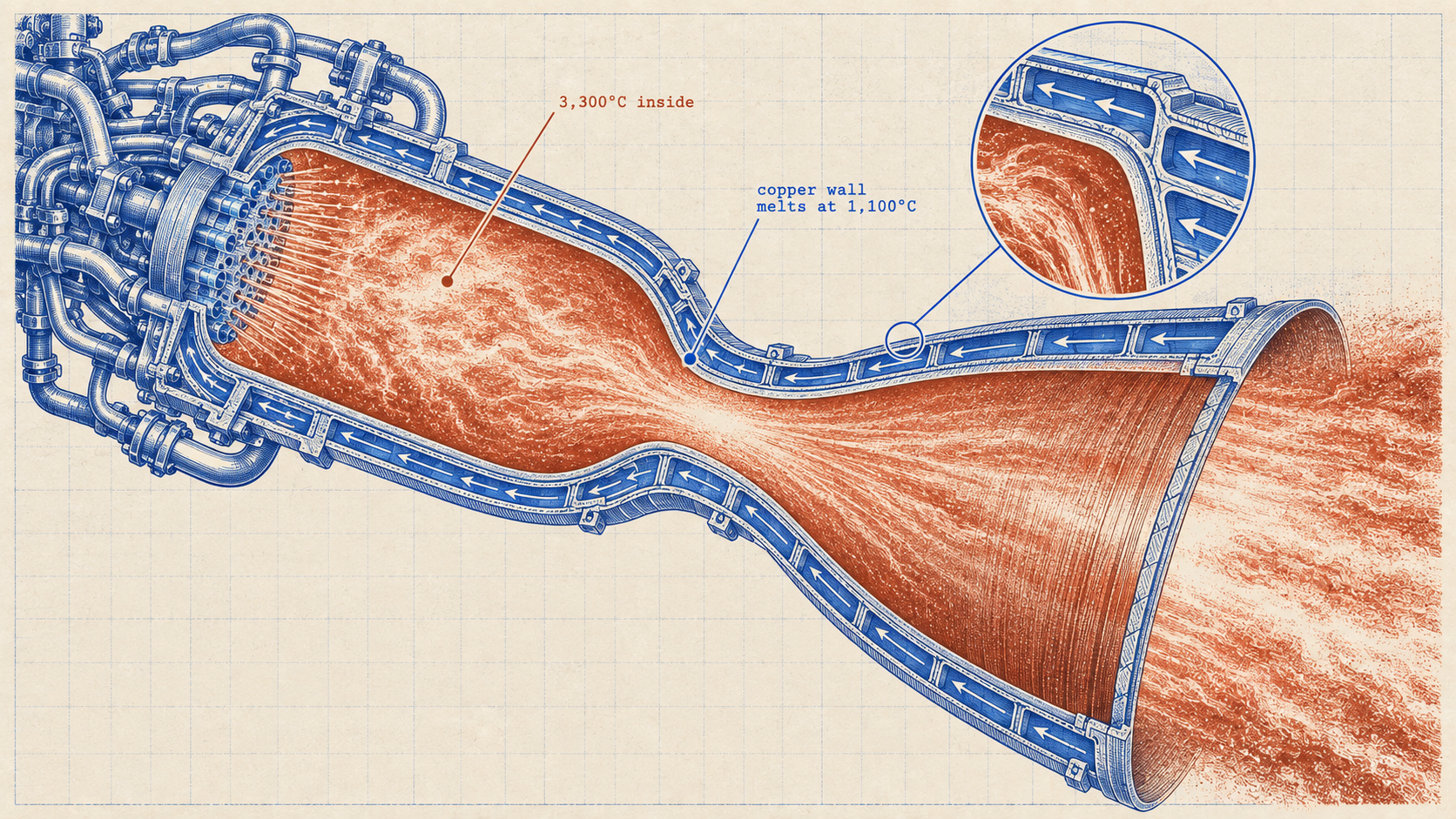
Those channels are why engines used to take so long to build. Each one had to be cut into the metal and then sealed over. Now they can be printed. NASA’s LLAMA project 3D-printed a chamber from a copper alloy with the channels already inside it. Then it fired the engine more than 25 times to see if the chamber would hold. NASA says printing can cut the time to build an engine nozzle by more than half.
Printing has a problem of its own. Metal that is melted and cooled one thin layer at a time ends up with stress locked inside it. The part can look perfect and still warp or crack later. At Oak Ridge National Laboratory, researchers fire beams of neutrons through printed rocket parts for NASA. Neutrons pass through metal, so they can map the stress inside without cutting the part open.
The other lever is weight. Researchers at Lawrence Livermore National Laboratory build materials that are mostly empty space. Each one is a lattice of tiny struts, like a microscopic Eiffel Tower. They can be as light as foam and far stiffer. The lab now uses machine learning to design them, because there are more possible patterns than anyone could test by hand.
Every kilogram saved in a bracket or a frame is a kilogram of something else that gets to come along.
All of this is tested in computers long before it is tested in fire. An engine that fails on the test stand usually destroys itself, so engineers simulate first and build later. A rocket engine is designed in models, then corrected on test stands until the models become less wrong.
Chemical rockets are still the only way to get off the Earth. For the long trip between planets, there are other options. An ion engine uses electricity to fire out a thin stream of charged gas. The push is tiny, about the weight of a sheet of paper resting on your hand. But it can run for years on very little fuel. NASA’s Dawn probe used one to visit two different worlds in the asteroid belt.
A nuclear rocket would heat its fuel with a reactor instead of burning it, and could take months off the trip to Mars. A shorter trip is also the most reliable radiation shield. NASA and DARPA planned a test flight called DRACO, but it was cancelled in 2025. One reason given was that ordinary launches had become so cheap.
The rocket equation has not gone anywhere. It has just become cheaper to pay.
Slow down to catch up
Steering a spacecraft is its own kind of strange. On Earth, you point at where you want to go and drive. In orbit that does not work, and the first people to try it found out the hard way.
In June 1965 the crew of Gemini IV tried to fly over to the spent rocket stage that had carried them up. It was floating right there ahead of them. The pilot, Jim McDivitt, pointed at it and fired his thrusters. The booster drifted farther away. He tried again, and it drifted farther still. He gave up after burning nearly half the mission’s fuel.
Nothing was broken. He was just driving like someone on Earth.
Here is what went wrong. In orbit, the higher you are, the longer each lap around the Earth takes. The space station, 400 kilometers up, gets around in 90 minutes. GPS satellites, fifty times higher, take 12 hours. The Moon takes 27 days.
Now add the strange part. Firing your engine forward does not move you ahead along your lap. It pushes you up into a higher one. So when McDivitt hit the gas, he climbed. His lap got longer. The booster stayed on its shorter lap below him and pulled ahead, like a runner on the inside lane of a track.
To catch it, he needed to do the opposite and hit the brakes. Braking drops you lower, onto a shorter lap. You come around sooner than your target and close the gap. Then you speed up again to climb back to its height.
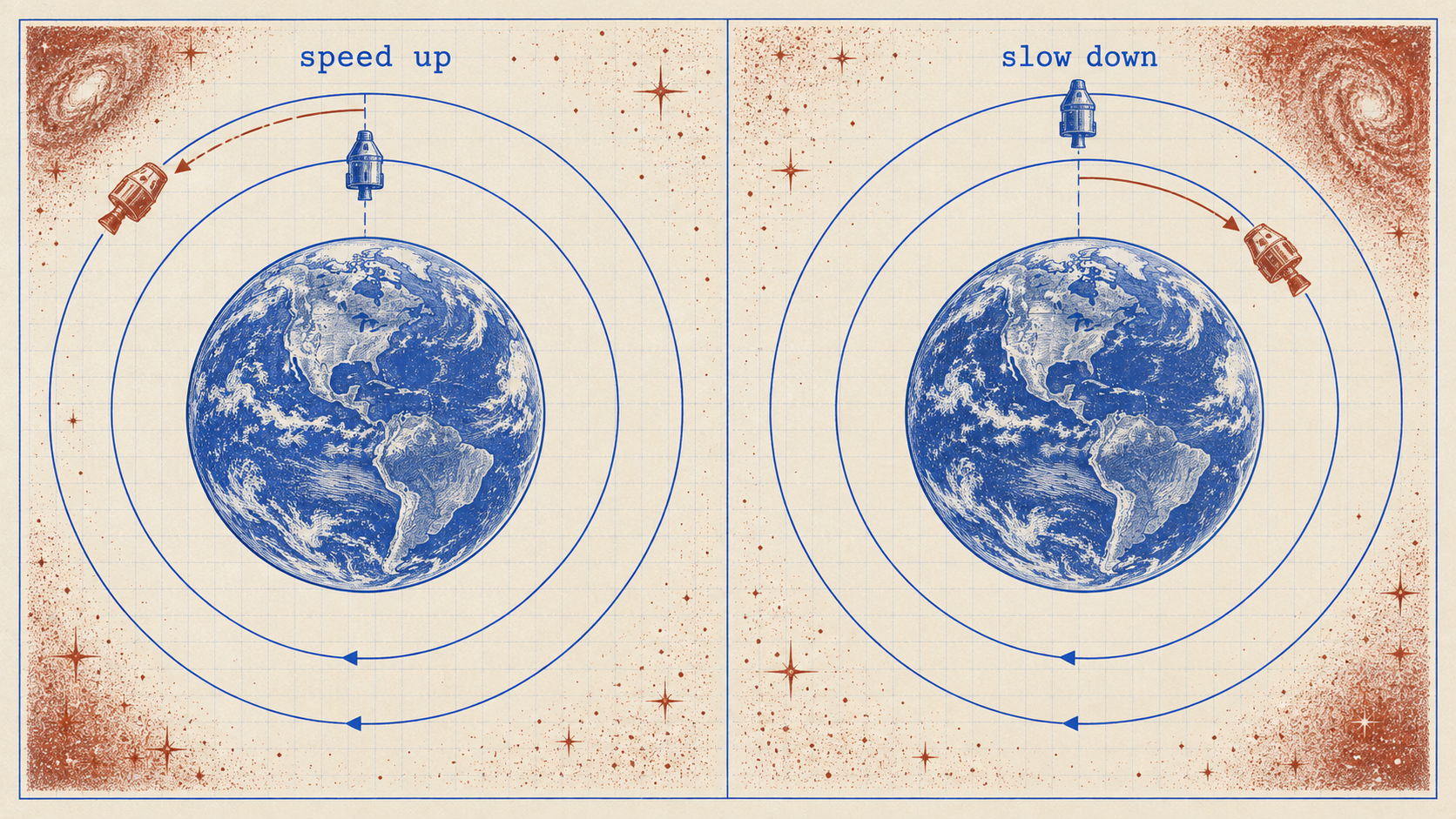
Six months later another Gemini crew did exactly that, and brought two spacecraft within a foot of each other.
Going to another planet adds a second problem, which is that everything is moving. You do not aim a spacecraft at Mars. You aim it at the empty spot where Mars will be when you arrive, months from now. And you launch when Earth and Mars are lined up to make that trip as short as possible. That happens once every 26 months, and the window stays open for a few weeks.
Miss it and you wait two years.
The same clock runs on the way home. A crew that lands on Mars cannot leave when they like. They have to wait for the planets to line up again, which takes about 500 days. Add the trip each way and a Mars mission lasts about two and a half years. There is no way to cut it short if something goes wrong.
Even the math gets harder. With two bodies, like the Earth and one spacecraft, Newton’s laws give an exact answer. You can predict the orbit forever. Add a third body, like the Sun or the Moon, and no exact formula exists. Computers have to work the path out one small step at a time, and small errors grow. This is why spacecraft fire their engines for small corrections along the way.
If the phrase “three-body problem” sounds familiar, it is the title of Liu Cixin’s novel and the Netflix series made from it. The story grows out of this exact piece of physics. An alien world orbits three suns. There is no way to predict how three bodies will move, so its people never know whether the next season brings mild weather or fire. The novel sets that world at Alpha Centauri, the same nearest star system from the start of this essay. It really does have three stars.
The James Webb Space Telescope lives inside this problem. It sits 1.5 million kilometers from Earth, circling a point where the pull of the Sun and the pull of the Earth balance out. There is nothing at that point. It is just a place where the math works. The balance is delicate, like one of those stacks of stones people build on a beach. It holds, but only if nothing nudges it. So Webb fires its thrusters about every three weeks to stay in place.
On Earth, distance is about how far. In space, it is about when.
Nobody is coming
The Moon is close enough that a conversation still feels like a conversation. A radio signal gets there in a little over a second.
Mars is different. Depending on where the two planets are, a message takes between 4 and 24 minutes to arrive. The reply takes just as long to come back. Ask a question and you could wait 48 minutes for the answer. About every two years, the Sun passes between the two planets and Mars goes quiet for two weeks.
When the Perseverance rover landed in 2021, the delay was about 11 minutes and the landing took seven. By the time mission control saw the rover hit the top of the atmosphere, it had already been sitting on the surface for several minutes, in one piece or not.
They were watching something that had already happened.
Even the worst places on Earth are not like this. A problem in Antarctica can be desperate, but Earth remains part of the response. A specialist can advise in real time. A patient can be flown out when the weather allows.
When it does not allow, you get stories like Leonid Rogozov’s. In 1961 he was the only doctor at a Soviet Antarctic base, in the middle of the polar winter, when he came down with appendicitis. No plane could reach him. So he took out his own appendix, with local anaesthetic, a mirror, and a meteorologist handing him the instruments. He was back at work in two weeks.
On Mars, every day is that winter.
The next flight home leaves when the planets line up, which can be more than a year away. Whatever happens, the crew has to handle it with what they have.
This changes what a mission is. At some distance, a crew stops being a remote team and starts becoming a small society of its own. Medicine becomes local. Manufacturing becomes local. Judgment becomes local. Ground control becomes less like command and more like correspondence.
NASA is already rehearsing this. In October 2025 four volunteers began 378 days sealed inside a 3D-printed Mars habitat at the Johnson Space Center in Houston. Every message to the outside was held back by up to 22 minutes. They were the second crew to do it. Researchers want to know how people solve problems when nobody can help in real time.
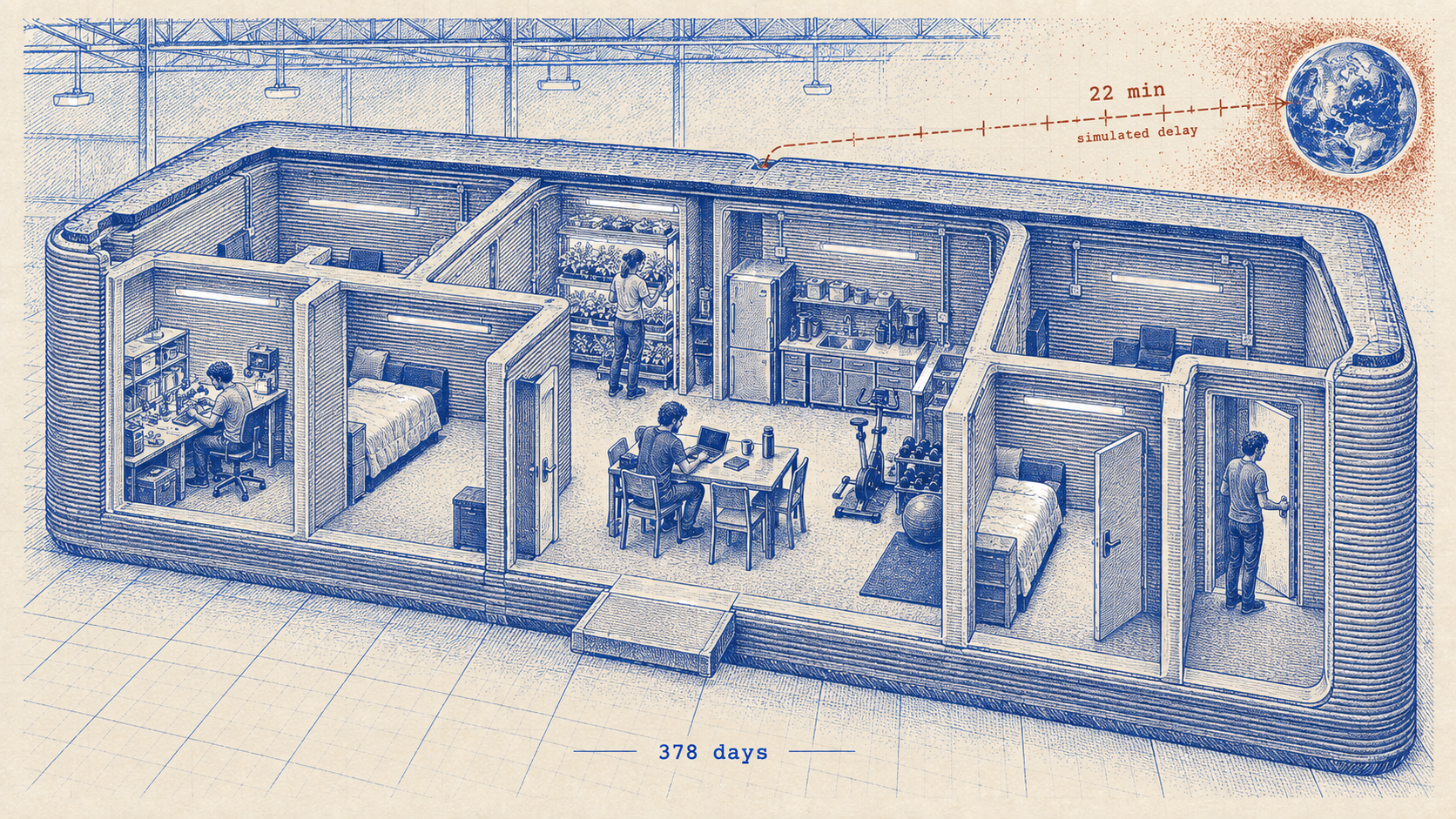
At what distance does an expedition become a society? It may happen sooner than anyone plans. Picture a settlement where every message home takes twenty minutes, the next ship leaves in two years, and the children cannot stand up in Earth’s gravity.
Nobody has to declare independence. They are already on their own.
No outside
On Earth, almost everything has an outside. Trash goes away. Spare parts arrive. The air is just there. Food comes from a supply chain so long that most of us only ever see the last few meters of it.
A space habitat has no outside. There is no atmosphere to dilute a mistake, no soil underfoot, no warehouse down the road. Every breath of air and every drop of water has to be used again.
The space station is the furthest anyone has taken this. Its life-support system now recovers 98 percent of the water the crew uses, including their sweat, their breath and their urine. Astronauts have a joke about it. Today’s coffee is tomorrow’s coffee. NASA’s water manager puts it more carefully. What the crew drinks has been cleaned until it is purer than most tap water on Earth.
The last 2 percent still matters.
On a two-and-a-half-year Mars mission, every percent the system loses is more than a hundred kilograms of extra water that has to be launched.
Water is the easy loop. Food and air are harder, because they need living things. The European Space Agency has spent more than thirty years on a project called MELiSSA, which tries to copy the way a lake recycles itself. Bacteria break down the waste. Algae turn carbon dioxide back into oxygen and food. In a pilot plant in Barcelona the “crew” is three rats, kept alive for months on air made by a tank of algae.
Growing actual meals has been tested in Antarctica. In 2018 a German engineer named Paul Zabel spent the polar winter running a greenhouse inside a shipping container, with no soil and no sunlight. In nine and a half months he grew 268 kilograms of vegetables, including 67 kilograms of cucumbers, in a space the size of a parking spot.
The big warning comes from Arizona. In 1991 eight people sealed themselves inside Biosphere 2, a three-acre glass greenhouse with its own rainforest, farm and tiny ocean. They planned to stay two years. Within 16 months the oxygen had fallen from 21 percent to 14, like living at 4,500 meters. The crew were getting altitude sickness, and oxygen had to be pumped in from outside.
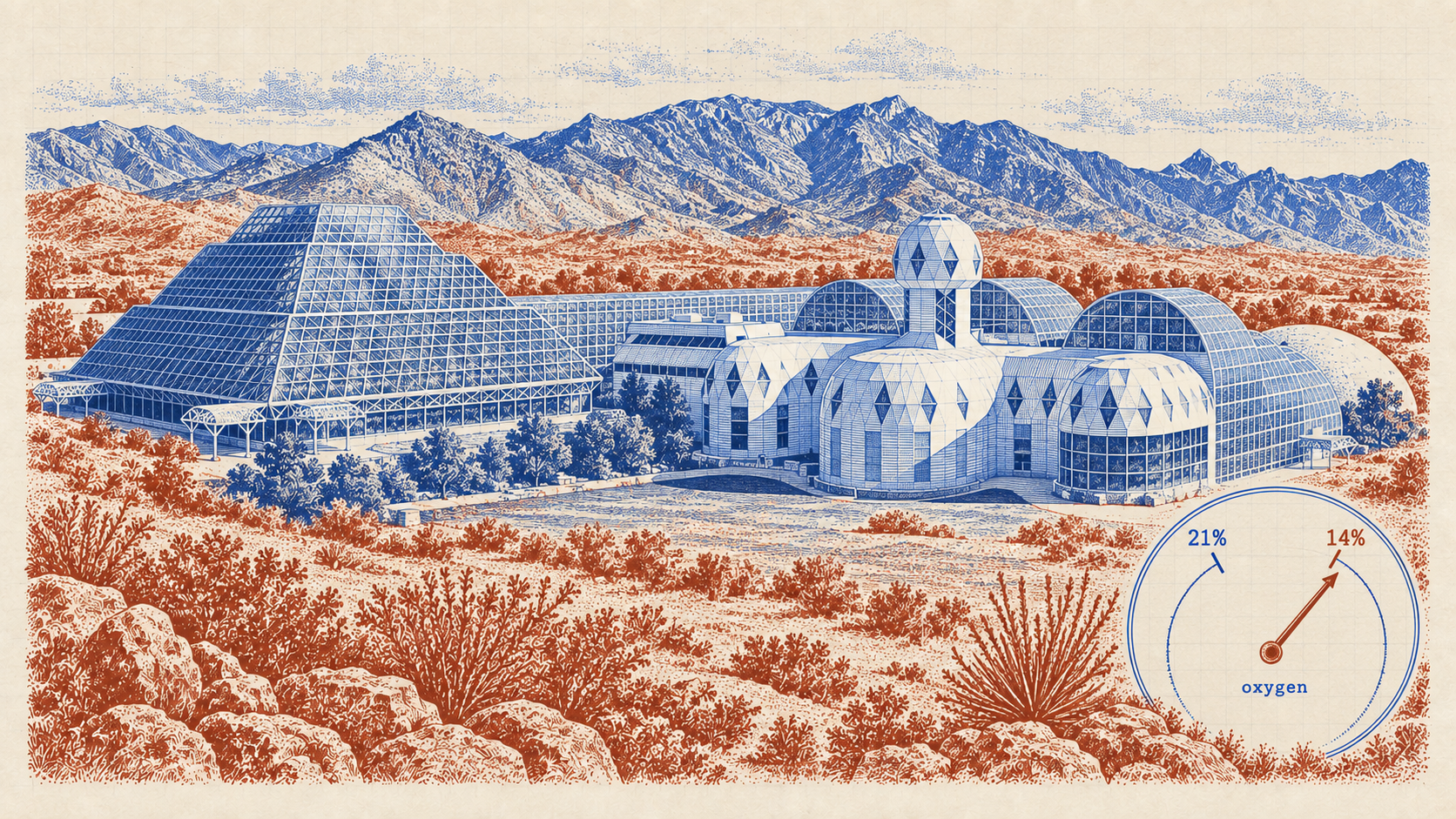
It took a while to work out where the oxygen had gone.
The soil had been made extra rich, and the microbes in it were using up oxygen faster than the plants could replace it. That should have filled the air with carbon dioxide, which the plants could have used. But the carbon dioxide was quietly soaking into the building’s fresh concrete. Nobody had thought of the walls as part of the ecosystem.
In a sealed world, everything is part of the ecosystem.
Some supplies cannot be stored at all. Vitamins break down on the shelf, and a Mars mission lasts longer than some of them do. So NASA is testing packets of engineered baker’s yeast on the space station. Add water, wait, and the yeast makes the nutrient fresh. Researchers see this as the start of something bigger, with microbes making medicines, plastics and building materials from whatever is on hand.
And some things can be made from the planet itself. MOXIE, a box the size of a toaster on the Perseverance rover, pulled oxygen out of Mars’s carbon dioxide air 16 times. In total it made 122 grams, about what a small dog breathes in ten hours. That is tiny, and it was also a first. It was the first time anyone had made something useful out of another planet.
Every one of these experiments is an attempt to replace something Earth does for free.
Millimeters matter
The big dangers of space are the famous ones. A surprising number of the real problems are smaller than a grain of rice.
In orbit the trouble is speed. Everything up there moves at around 10 kilometers per second, and at that speed size stops being reassuring. In 1983 a fleck of paint a fifth of a millimeter wide hit the Space Shuttle Challenger and gouged a pit in its window. NASA reckons a paint fleck one centimeter across would hit like a 250-kilogram object at highway speed. Millions of pieces that size or smaller are circling the Earth, and almost none of them are tracked.
In December 2022 something punched a hole 0.8 millimeters wide in the cooling system of a Soyuz capsule docked at the space station. Russian engineers blamed a micrometeoroid. Remember the capsule that could have had Scott Kelly home within hours? This was that capsule, for a later crew. With its coolant gone it was judged unsafe to fly, and a replacement had to be launched empty. Three people who had gone up for six months stayed for more than a year. One of them, Frank Rubio, came home with the American record for the longest spaceflight, 371 days.
All because of a hole smaller than a pinhead.
You cannot armor a spacecraft against this, because armor is heavy. The trick, invented by the astronomer Fred Whipple in the 1940s, is to stop trying to block the particle. A thin sheet of metal is mounted a few centimeters out from the real hull. The particle hits the sheet so fast that it shatters into a spray of fragments. By the time the spray crosses the gap it has spread out, and no single piece has the punch to get through the wall. The space station is wrapped in hundreds of these shields, some with layers of bulletproof fabric stuffed into the gap.
On the Moon the small thing is dust, and it is nothing like the dust at home. Earth’s dust has been tumbled smooth by wind and water. Moon dust was made by billions of years of meteorites smashing rock, and nothing has ever rounded it off. Under a microscope it looks like broken glass. It also carries a static charge, so it clings to everything.
The Apollo crews hated it. It scratched their visors, jammed their suit joints and clogged the seals on their sample boxes. It smelled like spent gunpowder. On Apollo 17 it gave Harrison Schmitt what he called lunar hay fever. It also wore through the outer layer of his boots in three days. His commander, Gene Cernan, told NASA afterwards that dust was probably the biggest obstacle to working on the Moon. Every other problem could be overcome, he said, except that one.
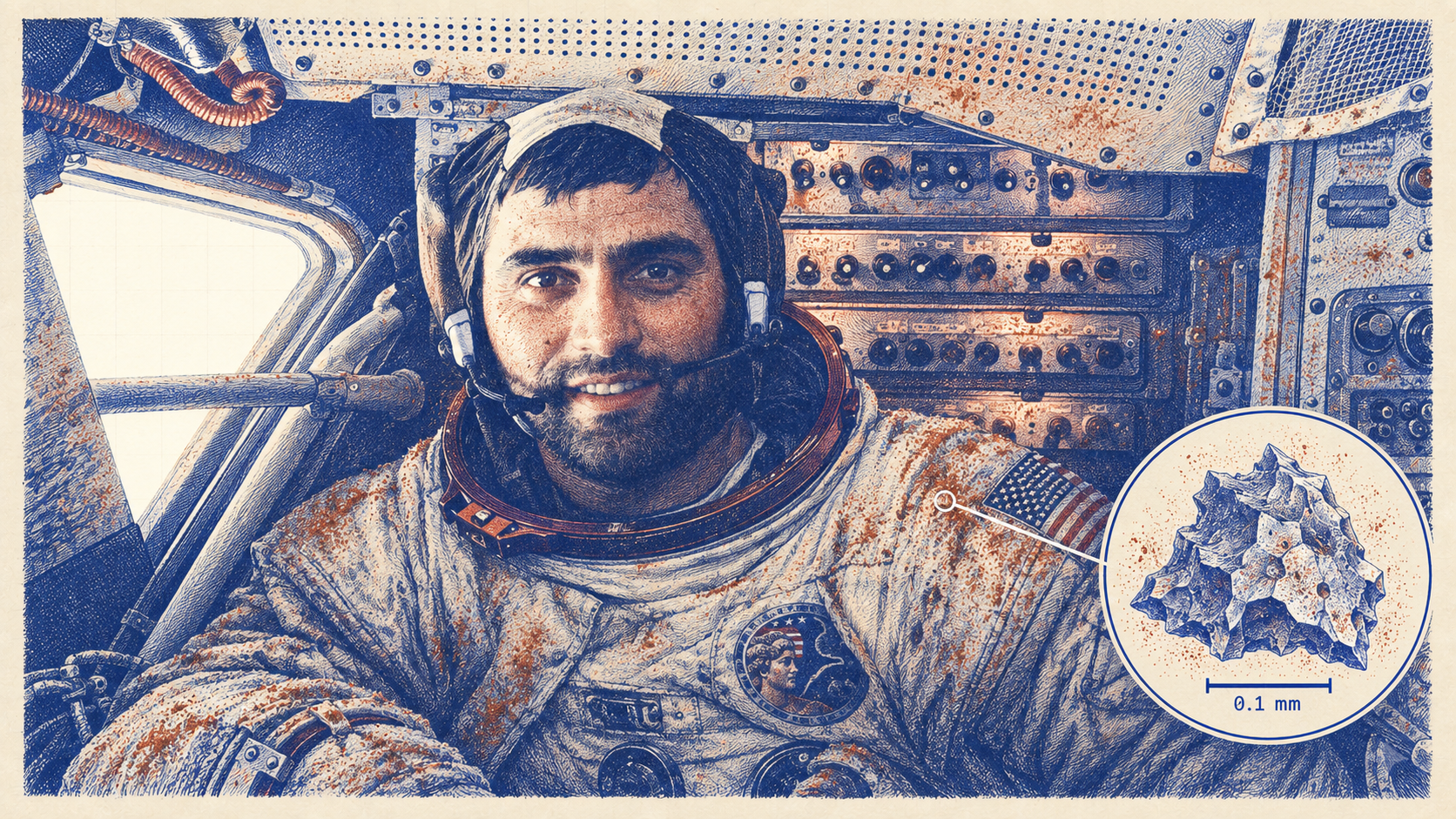
One fix is already being tested. In 2025 NASA tried out an electric dust shield on the Moon, aboard a commercial lander. It runs a pattern of electric fields across a surface, and the dust jumps off. It worked on glass and on radiator material.
Mars dust is finer, it gets everywhere, and it has already ended two NASA missions. A planet-wide dust storm in 2018 blotted out the Sun for months and finished the Opportunity rover after 14 years of work. Four years later the InSight lander died because dust had piled up on its solar panels. By the end they made a tenth of the power they had at landing.
Rockets get the attention. But whether people can stay out there may come down to whether a door seal still works after a year of dust.
Habitable for what?
Everything so far has been about the Moon and Mars. Surely there is somewhere better. Every few months a headline announces a new habitable planet. The word means less than it sounds. To an astronomer, a planet is in the habitable zone if it sits at the right distance from its star for liquid water to exist on the surface. It assumes the planet has the right kind of atmosphere, and it promises nothing else.
By that definition, Mars is in the Sun’s habitable zone. You have just read what it would do to you.
The most famous case is TRAPPIST-1, a small red star 40 light-years away with seven Earth-sized planets, three of them in the habitable zone. It is the best place we know of to look. So far the looking is mostly ruling things out. The Webb telescope has found that the two innermost planets probably have no thick atmosphere at all. For TRAPPIST-1 e, the most promising of the seven, Webb still cannot say whether there is any air there. Small red stars flare violently, and they may strip the atmosphere off anything close enough to them to be warm.
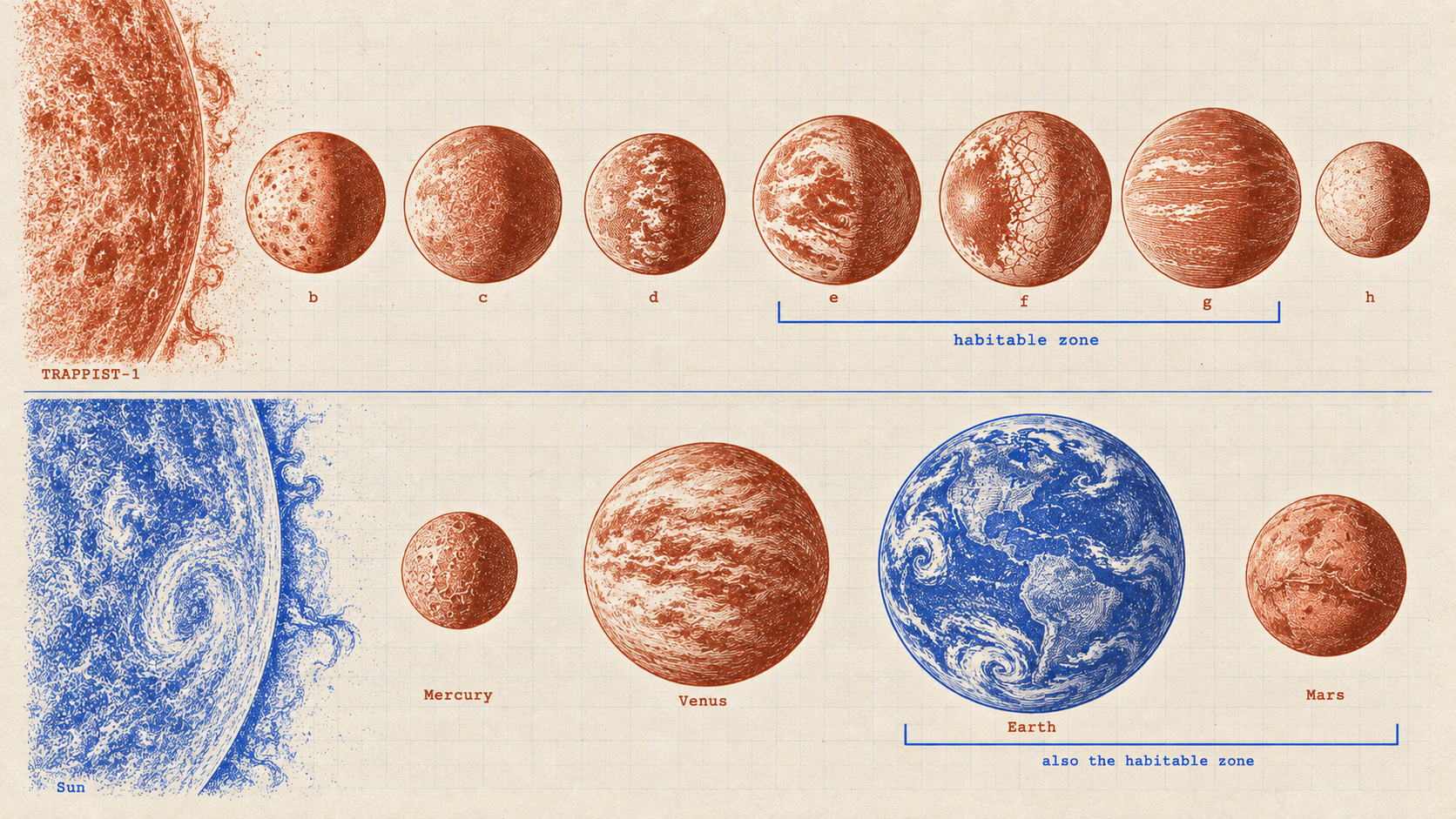
And 40 light-years is ten times farther than the star Voyager could not reach in 75,000 years.
NASA’s next big telescope after Webb is the Habitable Worlds Observatory. It is being designed to take direct pictures of a couple of dozen Earth-like planets and check their atmospheres for oxygen and methane. Its job is to find out whether anything lives on them. It is not looking for places we could move to.
Even a planet with life on it would probably not be one we could use. Microbes live in boiling springs and inside solid rock a kilometer underground. We need almost exactly the conditions we left.
Nothing is habitable on its own. It is habitable for someone, and we turn out to be very hard to please.
Allowed by physics
Most of the space technology in science fiction is not impossible. Physics allows it. What is missing is usually a material that does not exist yet, or a power supply, or a factory. So here is a wish list, in order, from the nearly here to the barely imaginable.
The first item on the list is the space elevator. The idea goes back to the 1890s. Hang a cable from a satellite in orbit down to a spot on the equator. Then ride up it, like a very tall lift, instead of riding a rocket. Nothing in physics says no. The problem is the cable.
It would have to be about 100,000 kilometers long. It would also have to hold up its own weight the whole way. A steel cable breaks itself at around 50 kilometers. Carbon nanotubes are strong enough on paper. The longest one anyone has grown is half a meter.
Nobody needs new physics for a space elevator. They need a cable.
Suppose you get up there. The next thing to run out of is fuel. There is a way around that too, and unlike the elevator, it already exists. It is called a solar sail.
Sunlight pushes on whatever it hits. The push is tiny. On a square meter, out at Earth’s distance from the Sun, it is about the weight of a grain of sand. But it never stops, and it costs nothing. So make a sail big enough and thin enough, and you have a kite that flies on light instead of wind.
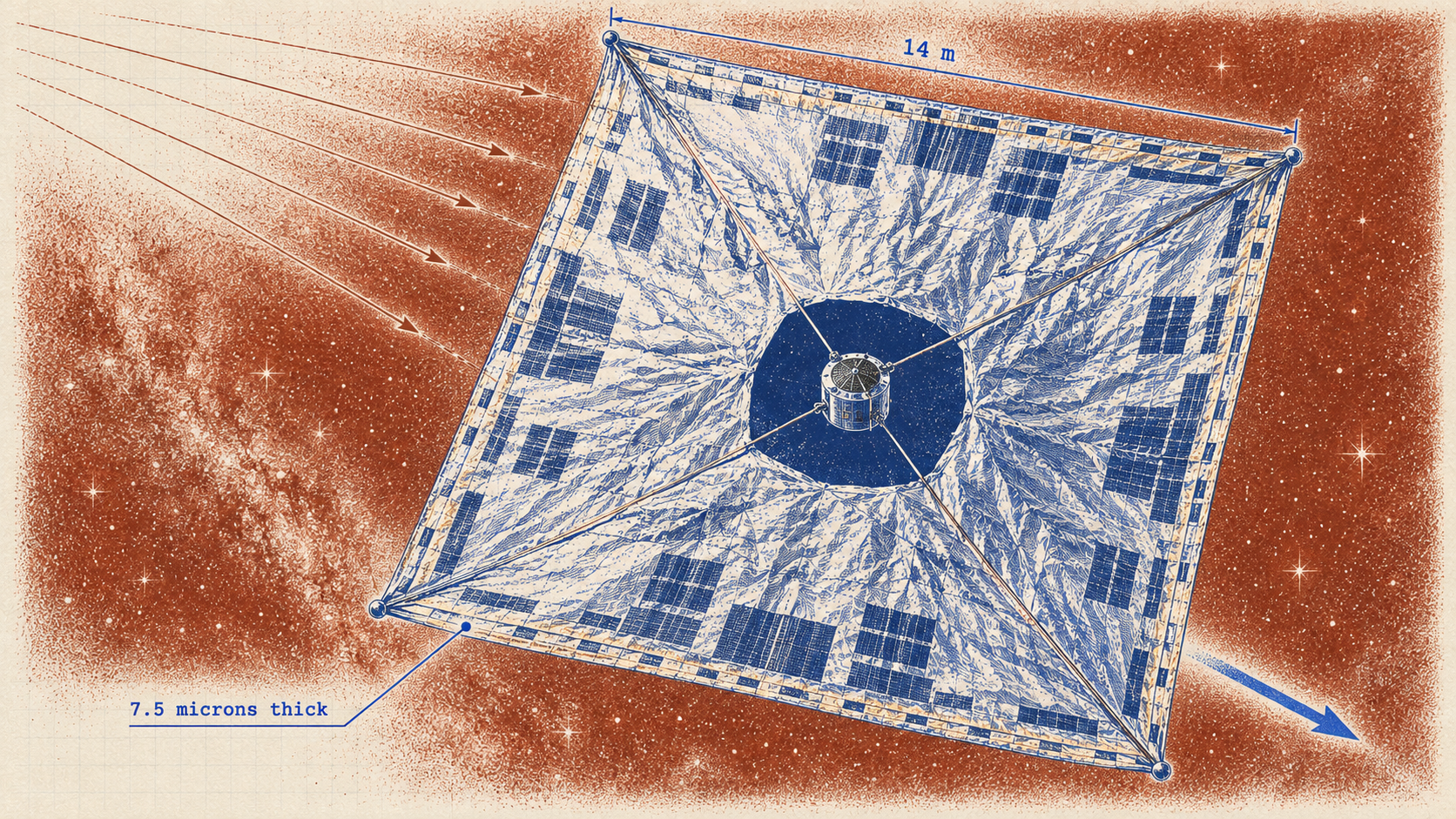
In 2010 a Japanese spacecraft called IKAROS unfurled a sail on its way past Venus. It was 14 meters square and thinner than a human hair, and the craft steered by it. In 2019 the Planetary Society’s LightSail 2 raised its own orbit using nothing but sunlight. NASA’s newest sail is testing lighter booms. The goal is much bigger sails that still fold into a box the size of a microwave.
A sail pushed by sunlight is slow, because sunlight is weak. But nothing says the light has to come from the Sun.
Breakthrough Starshot wants to use a laser. The plan is a spacecraft the size of a postage stamp, glued to a sail a few meters wide. From the ground, an array of lasers would hit that sail with 100 gigawatts for a few minutes. That is roughly the output of a hundred large power plants, all aimed at a kite. It would push the craft to a fifth of the speed of light. It could reach Alpha Centauri in about 20 years.
Voyager would take 75,000.
The catch is that none of the parts exist yet. There is no 100-gigawatt laser, no sail that can survive one, and no radio the size of a stamp that can call home from four light-years away. People are working on all three.
That laser raises a bigger question. Where does a civilization get that kind of power? One answer is to collect it where the Sun never sets.
In 2023 a Caltech experiment in orbit beamed a small amount of power to a receiver on a rooftop in Pasadena. It was the first time solar power collected in space had been sent to the ground. The dream is satellites that soak up sunlight around the clock, with no night and no clouds, and beam it down. The obstacle is cost and scale. It is a long way from a rooftop receiver to a power station.
Push the idea to its limit and you get the Dyson swarm, a cloud of collectors wrapped around an entire star. None exists, and none is planned. But if some other civilization has built one, physics says the waste heat has to go somewhere. Astronomers now look for stars that glow too warmly in the infrared.
And if the question is how to pack the most energy into the least weight, physics has one answer that beats everything else.
Every kind of particle has a mirror twin with the opposite electric charge. That is antimatter. When a particle meets its twin, both vanish, and all of their mass turns into energy. Burning gasoline releases less than a billionth of the fuel’s mass as energy. A nuclear reactor releases about a tenth of a percent. Antimatter releases all of it.
A gram of antimatter meeting a gram of ordinary matter would give off about as much energy as burning four thousand tonnes of gasoline. In principle, a spacecraft could carry the fuel for a trip to Mars in a container you could hold in one hand.
Antimatter is not science fiction. Hospitals use it every day. A PET scan works by injecting a tracer that gives off antimatter particles. The scanner then watches for the flashes where they meet ordinary matter. CERN makes it too, in tiny amounts. All the antimatter it has ever produced adds up to less than ten billionths of a gram, enough to run a light bulb for about four hours.
Physics allows it. It just allows it in a form we can barely touch.
Gravity, radiation and distance are not going to change. A cable, a laser and a factory are things we have not built yet. That is a different kind of problem, and a more hopeful one.
What has to come with us
None of this means space is out of reach. We have walked on the Moon. We have kept people alive in orbit without a break since 2000. We have flown a sail on sunlight, recycled 98 percent of a crew’s water, and pulled oxygen out of Martian air with a box the size of a toaster. The work is no longer imaginary.
So what does the near future look like? Probably less like escape and more like a long supply line, stretched a little further each decade.
Some of the pieces are already in place. Reusable rockets have cut the price of a kilogram in orbit by a factor of twenty. NASA’s plan for its next Moon landing depends on refueling in orbit, so the lander does not have to leave the ground carrying fuel for the whole trip. And the first oxygen has already been made on Mars, even if it was only enough for a small dog.
Other pieces are further off. Closed-loop life support, from the station’s water system to the greenhouse in Antarctica, decides how long a crew can stay, and no loop is closed yet. A nuclear rocket would shorten the trip to Mars, but the one test flight that was planned was cancelled in 2025. And beyond all of that sit the ideas waiting on a material or a power supply. A cable 100,000 kilometers long. A hundred power plants aimed at a kite.
The Moon may become the proving ground, because it is three days away and mistakes there can be survived. Dust, two-week nights, partial gravity, and building things out of the ground will all get their first real test there.
Mars is where the stakes go up. There, the next ship home leaves in two years and nobody is coming before then. It may be the first real test of whether a settlement can absorb its own failures. Asteroids may matter less as treasure chests than as water and metal for work that no longer begins on Earth.
These are not separate ambitions. Each one pushes back one of the limits from earlier in this essay. Cheaper launch pushes the limit on mass. Shielding pushes the limit on radiation. Centrifuges push the limit on gravity. Closed loops push the limit on how long anyone can stay. Simulation pushes the limit on what can be tested at all.
No single field owns this. The doctors who studied Scott Kelly are working on it. So are the engineers printing rocket engines, the ecologists who worked out where Biosphere 2’s oxygen went, and whoever ends up writing the first laws on Mars. They are all asking the same question. How far can a species move from the environment that shaped it before survival requires redesign?
The question is not only whether we can go. We can go. The harder question is what has to come with us.
How much gravity is enough for a childhood? How much shielding is enough for a family whose grandchildren will be born there? How closed can a habitat become before it turns brittle? How far from Earth can a town be before it stops taking orders from home? Are we trying to settle other worlds, or are we trying to build small pieces of Earth and carry them with us?
The future of space exploration may depend less on a single heroic breakthrough than on a serious account of these thresholds. Some will be solved by engineering. Some by biology. Some by economics. Some by governance. Some may not be solved cleanly at all.
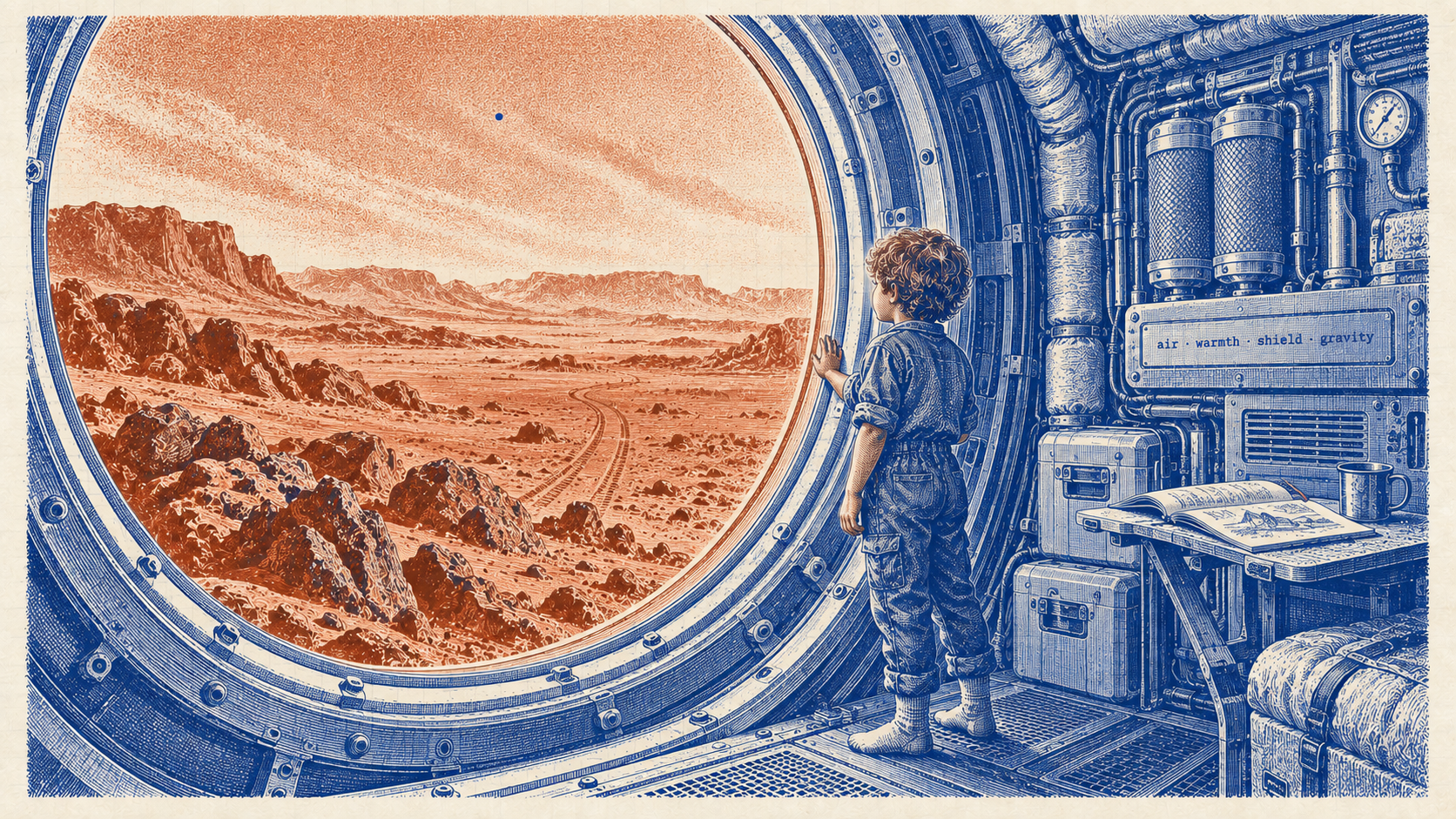
Space is hard because it exposes the assumptions hidden inside being human. Earth was never just the ground under our feet. It was the whole set of conditions our bodies, our tools, and our habits were built for. To live beyond it, we have to learn which parts of that can travel, which parts can be rebuilt, and which parts may force us to change.
To live in space, we have to learn what Earth is doing for us.
Sources and further reading
Introduction
NASA Exoplanet Exploration — NASA’s running count of confirmed planets around other stars, which passed 6,000 in 2025.
A year without Earth
NASA Twins Study — the year-long comparison of astronaut Scott Kelly in orbit with his identical twin Mark on Earth, including the telomere, gene-expression and cognition results.
ESA: The return home — how a Soyuz capsule gets a station crew from undocking to the ground in under four hours, and its role as the station’s lifeboat.
How much gravity does a human need?
NASA: The Human Body in Space — NASA’s overview of spaceflight health effects, including bone loss of 1 to 1.5 percent a month.
NASA: Risk of Spaceflight Associated Neuro-ocular Syndrome — how common the eye syndrome is among station astronauts and why it is a priority before a Mars mission.
NASA Glenn: Spaceflight Associated Neuro-Ocular Syndrome — what happens to the eye when fluid shifts toward the head, and how NASA models it.
ESA: Testing the value of artificial gravity for astronaut health — the 2019 bed-rest study in Cologne, with 24 volunteers, 60 days head-down, and a daily spin in a centrifuge.
The weight of air
Space Safety Magazine: Jim LeBlanc’s vacuum chamber accident — the 1966 suit test in Houston in which a technician was exposed to near-vacuum for about 14 seconds and recovered.
NASA technical brief: Spacesuits — why suits run on pure oxygen at low pressure, and the limits the body sets on suit design.
NASA technical brief: Decompression sickness — the bends in spaceflight and the hours of oxygen pre-breathing before a spacewalk.
National Geographic: Astronauts’ fingernails and glove design — the study of 232 astronauts that found about one in ten had fingernail injuries from pressurized gloves.
Nowhere for the heat to go
NASA: Weather on the Moon — lunar surface temperatures from 121°C in daylight to −133°C at night, and the two-week lunar night.
NASA History: Apollo 8, you are go for TLI — the slow “barbecue” roll Apollo spacecraft used to even out heating on the way to the Moon.
NASA: ISS Active Thermal Control System overview — how the station collects waste heat in ammonia loops and radiates about 70 kilowatts to space.
Space Center Houston: Cooling garments — the water-cooled garment worn under spacesuits, with roughly 300 feet of tubing.
NASA: Apollo 13 mission details — the power-down after the accident, when the cabin fell to 38°F.
The shield overhead
Science News: Apollo astronauts and cosmic-ray light flashes — the flashes crews saw with their eyes closed, and the experiments that traced them to cosmic rays.
NASA: Protecting astronauts from space radiation at the Moon — includes the August 1972 solar storm that fell between Apollo 16 and Apollo 17.
JPL: Curiosity’s radiation measurements on the way to Mars — the detector that measured the dose during the cruise, and the whole-body CT scan comparison.
Scientific American: New space radiation limits for NASA astronauts — the 600-millisievert career limit for all astronauts, and why a Mars mission would exceed it.
Scientific Reports: Polyethylene as radiation shielding aboard the ISS — open-access study of polyethylene and Kevlar shielding tested aboard the station.
Brookhaven National Laboratory: NASA Space Radiation Laboratory — the facility that fires beams of heavy ions at cells, electronics and shielding materials to mimic cosmic rays.
NASA: Radiation shielding materials containing hydrogen, boron and nitrogen — Langley research on boron nitride nanotubes as a combined structure and shield.
DLR: AstroRad vest results from Artemis I — 2026 findings from the Helga and Zohar mannequins on how much a radiation vest cuts solar-storm dose.
Everything has to be lifted
NASA Glenn: Ideal rocket equation — a plain explanation of why a rocket has to carry fuel to lift its fuel.
Scientific American: Escaping the tyranny of the rocket equation — astronaut Don Pettit’s argument, including why a rocket on the pad is 85 to 90 percent propellant.
Harry Jones (NASA): The recent large reduction in space launch cost — 2018 paper comparing the Space Shuttle at about $54,500 per kilogram to orbit with Falcon 9 at about $2,700.
A controlled explosion
NASA: Producing methane and oxygen on Mars — research on making rocket propellant from Martian carbon dioxide and water.
NASA: LLAMA additive manufacturing project — the 3D-printed copper-alloy combustion chamber, its hot-fire tests, and the time saved by printing.
Oak Ridge National Laboratory: 3D-printed rocket parts and neutrons — using neutron beams to map the stress locked inside printed engine parts for NASA.
LLNL/MIT: ultralight, ultrastiff 3D-printed materials — the lattice materials that are mostly empty space and as light as foam.
LLNL: machine learning for lattice structures — using machine learning to search the huge space of possible lattice designs.
JPL: Dawn arrives at Ceres — how an ion engine with the thrust of a sheet of paper took a probe to Vesta and Ceres.
NASA/DARPA DRACO announcement — the 2023 announcement of a nuclear thermal rocket test flight, since cancelled.
SpaceNews: Why DARPA cancelled DRACO — falling launch costs and new analysis behind the 2025 cancellation.
Slow down to catch up
NASA Kennedy: Gemini IV, learning to walk in space — the 1965 mission whose crew tried and failed to fly up to their own spent booster.
NASA: Mars mission timeline — why the efficient route to Mars opens about once every 26 months.
NASA NSSDCA: A crewed mission to Mars — long-stay mission profile with up to 500 days on the surface and a round trip of about 900 days.
NASA: Webb’s orbit — how the telescope circles the L2 balance point 1.5 million kilometers from Earth and holds its position with regular thruster burns.
Nobody is coming
NASA: Space communications, 7 things you need to know — includes the 4 to 24 minute one-way delay between Earth and Mars.
JPL: What’s Mars solar conjunction, and why does it matter? — the two weeks every two years when the Sun disrupts contact with Mars.
JPL: Perseverance landing press kit — the landing timeline and the 11 minute 22 second signal delay.
BMJ: Auto-appendectomy in the Antarctic — case report on Leonid Rogozov’s 1961 operation on himself, co-written by his son.
NASA: CHAPEA crew begins second Mars habitat mission — the 378-day simulated Mars stay in Houston, with communication delays of up to 22 minutes.
No outside
NASA: Water recovery milestone on the space station — the 98 percent water recovery rate, how the brine processor works, and what the crew is actually drinking.
ESA: MELiSSA — the decades-long European project to build a closed loop for food, water and oxygen modelled on a lake ecosystem.
ESA: A decade-long quest to build an ecosystem in a room — the MELiSSA pilot plant in Barcelona, where algae keep a crew of three rats supplied with oxygen.
DLR: EDEN ISS — the Antarctic greenhouse project that grew vegetables through the polar night without soil or sunlight.
DLR: EDEN ISS project results — 268 kilograms of vegetables grown in 12.5 square metres over nine and a half months.
University of Arizona: Biosphere 2 — the sealed three-acre facility and the history of the 1991 to 1993 crew.
Severinghaus et al., Eos: Oxygen loss in Biosphere 2 — how soil microbes and fresh concrete drew the oxygen down from 21 to 14 percent.
NASA: What is BioNutrients? — engineered baker’s yeast that makes fresh nutrients on the space station.
Grand challenges in space synthetic biology — open-access paper on engineered microbes making food, medicines and materials off Earth.
NASA: MOXIE completes its Mars mission — final results, with 122 grams of oxygen made from Martian air over 16 runs.
Millimeters matter
NASA HVIT: Space Shuttle impact images — including the 1983 Challenger window pit from a 0.2 mm paint fleck.
NASA White Sands: Micrometeoroids and orbital debris — impact speeds and the paint-fleck comparison.
Space.com: Leaky Soyuz returns to Earth — the 0.8 mm hole in Soyuz MS-22 and the uncrewed replacement.
NASA HVIT: Shield development — how Whipple shields and stuffed Whipple shields break up an incoming particle before it reaches the hull.
NASA: Lunar regolith hazards — why Moon dust is sharp, clingy and damaging to suits, seals and lungs.
Space.com: Moon dust could be a problem for future lunar explorers — Apollo experiences with dust, including Schmitt’s boots and lunar hay fever.
NASA: Dust shield repels lunar regolith on the Moon — the 2025 Electrodynamic Dust Shield test on the Blue Ghost lander.
NASA: Opportunity rover mission comes to end — the 2018 global dust storm that ended the rover after 14 years.
NASA: InSight lander retired — dust on the solar panels and the loss of power in 2022.
Habitable for what?
NASA: Webb looks at TRAPPIST-1 e — what Webb can and cannot yet say about the atmosphere of the most promising TRAPPIST-1 planet.
NASA: Habitable Worlds Observatory — the planned telescope for imaging Earth-like planets and searching their atmospheres for signs of life.
Allowed by physics
Pugno: On the strength of the carbon nanotube space elevator cable — why a 100,000-kilometer cable needs carbon nanotubes, and why real ones fall short of the theory.
Guinness World Records: Longest carbon nanotube — the half-meter nanotube grown at Tsinghua University in 2013.
JAXA: IKAROS — the 2010 mission that unfurled a 14-meter solar sail and steered by it on the way to Venus.
The Planetary Society: LightSail — the 2019 mission that raised its orbit using sunlight alone.
NASA: Advanced Composite Solar Sail System — the sail mission testing lighter booms so that larger sails can fold into small spacecraft.
Breakthrough Starshot — the concept for laser-driven gram-scale probes to Alpha Centauri.
Caltech: Space Solar Power Demonstrator transmits power in space — the 2023 experiment that beamed power from orbit to a rooftop receiver in Pasadena.
NASA: Technosignatures — the search for signs of technology around other stars, including waste heat from Dyson-style structures.
CERN: Making antimatter — how little antimatter has ever been produced and how much energy it holds.