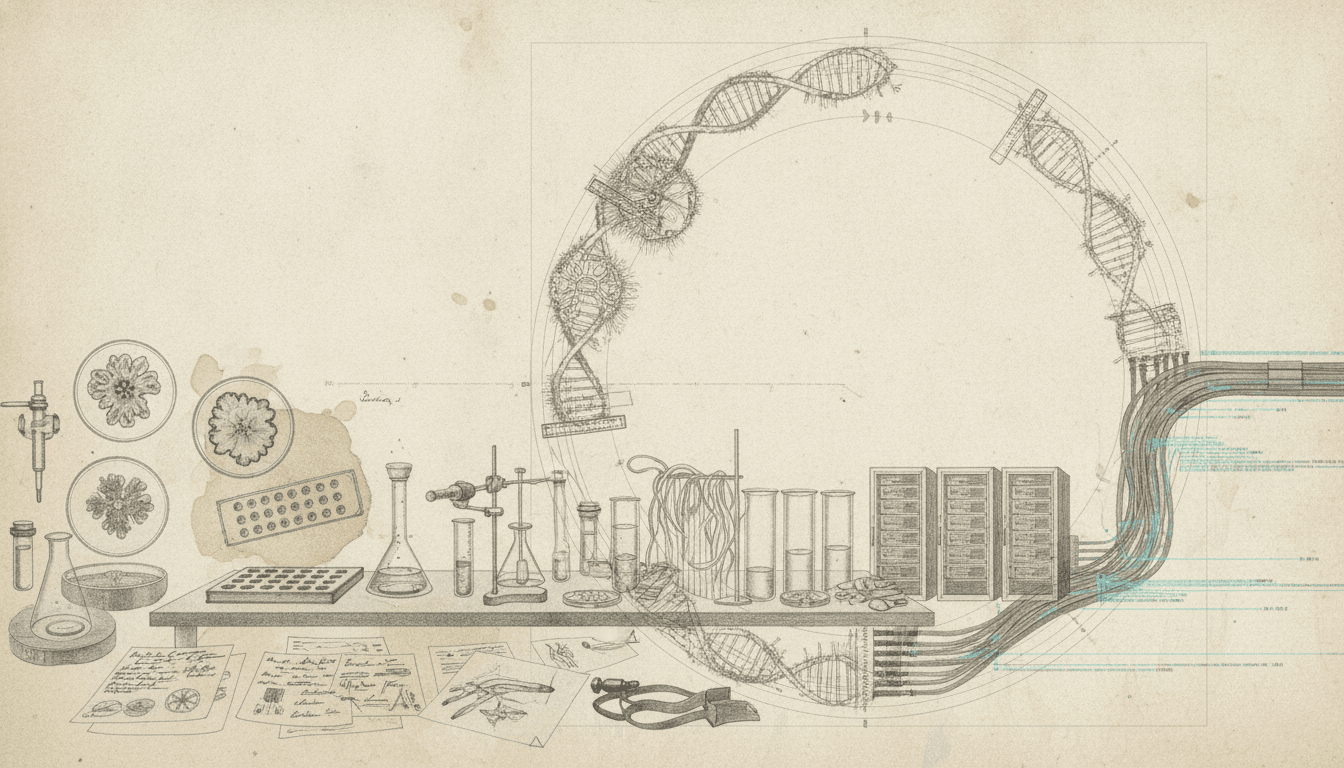
The wet lab becomes the data center when every experiment returns as training signal.
The signal
In software, the shape of the future is already visible.
A frontier model can inspect a large codebase, reason across thousands of files, identify a vulnerability, write a patch, run tests, observe the failure, change its approach, and try again. Anthropic’s work on Project Glasswing is one early signal of this pattern: the power is not just that a model can generate code. The power is that code gives the model a world it can act inside.
There is a compiler. There are tests. There is runtime behavior. There is hardware. There are logs, traces, exceptions, exploits, and benchmarks. The model can propose an action and then verify whether reality accepted it.
That is why cybersecurity has become one of the clearest demonstrations of what advanced AI systems are starting to do. A vulnerability is not merely predicted; it can be found, reproduced, patched, and validated against the system itself.
Biology is moving toward the same pattern, but with a harder interface to reality.
A model can propose an edited sequence, a molecule, an antibody, an RNA guide, or a new experimental protocol. But unlike code, the answer does not come back from a compiler in seconds. It comes back through synthesis, assays, instruments, cells, organisms, failed measurements, noisy readouts, and physical constraints. The central question is no longer whether AI can help biology. It is how to build environments where AI-generated biological ideas can be tested against the real world quickly enough for the system to learn.
The new operating system of science
We can see this already happening in industry. Recursion has built its strategy around large-scale biological and chemical datasets, automated wet-lab programs, and models trained over the resulting relationships. Boltz-2, released by MIT and Recursion, targets structure and binding-affinity prediction while running dramatically faster than physics-heavy methods in standard benchmarks. Chai-2 reports de novo antibody design with wet-lab validation in under two weeks. Evo 2 is a 40-billion-parameter genomic foundation model trained across more than 9 trillion nucleotides to reason over DNA, RNA, and proteins at long context.
The common thread is not “AI can summarize biology.” It is that models are starting to propose biological objects that can be tested. Once the lab result returns, the experiment becomes a new training signal. That is the point where AI starts becoming core company infrastructure.
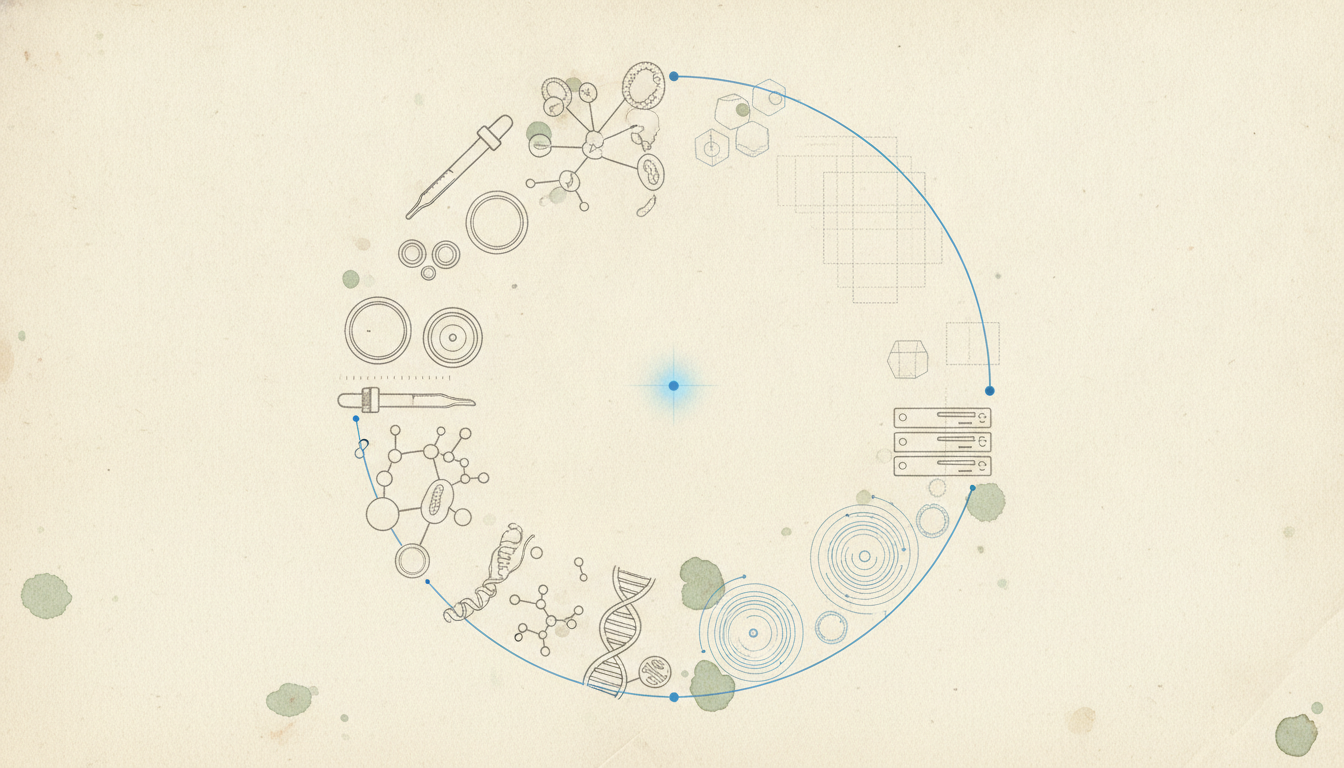
The discovery loop: data → model → design → experiment → measurement → retraining. Each pass through the loop compounds the organization’s private understanding of reality.
| Loop stage | What happens | Why it compounds |
|---|---|---|
| 1. Data | Sequences, assays, molecules, protocols, failures, clinical observations become structured memory. | Raw research activity becomes reusable context. |
| 2. Model | Foundation models and domain models reason over biological, chemical, and operational signals. | The model learns the local terrain instead of generic literature alone. |
| 3. Design | The system proposes edits, candidates, antibodies, molecules, guides, or next experiments. | Search becomes targeted by prior experimental truth. |
| 4. Experiment | Wet labs, robotics, synthesis partners, or clinical workflows test the design. | Reality, not narrative, scores the idea. |
| 5. Measurement | Assay results, toxicity, yield, binding, expression, phenotype, or failure returns. | The result becomes a reward signal. |
| 6. Retraining | Post-training, evaluation suites, and policies update the system. | Cycle time becomes the strategic variable. |
Discovery advantage ≈ proprietary data quality × validated experiments ÷ cycle time.
The equation is intentionally simple. It explains why the durable moat is not a prompt wrapper. It is the private substrate: assays, failures, protocols, molecules, expression data, perturbation results, imaging, clinical observations, notebook traces, and the institutional memory of what actually worked.
What the market is telling us
Benchling’s 2026 Biotech AI Report says AI has become a default interface for many scientists, with copilots and reasoning tools becoming a first stop across AI-using biotech organizations. The early wins are practical: literature extraction, protein structure and property prediction, scientific reporting, target identification. But the report also points to the ceiling: regulated science breaks when data is scattered, incomplete, and disconnected from workflows.
That is the business opportunity hiding under the hype. Every serious life-sciences organization will need a private discovery stack: trusted model access, structured research memory, evaluation suites, lab integrations, experiment tracking, provenance, safety policies, and post-training pipelines. The winning companies will not simply ask better questions of frontier models. They will teach models from their own experimental reality.
The regulatory ceiling
Biology is dual-use by default. A model that can reason about proteins, pathogens, genetic edits, synthesis constraints, and lab protocols can accelerate cures. The same general capability can create risk. Cyber has already reached this tension: the capability that finds the vulnerability is also the capability that could exploit it. Biology is harder because biological vulnerabilities cannot be patched with a pull request.
This is where blunt regulation can become a scientific ceiling. If frontier systems silently downgrade intelligence or refuse broad classes of biology questions, legitimate researchers lose a tool precisely where the tool is becoming most useful. Safety cannot be ignored. But the control point should be where digital intent becomes physical action: synthesis orders, lab execution, procurement, pathogen access, autonomous experimentation, and deployment. A refusal page is not a biosecurity architecture. It is a bottleneck.
▣ Governed acceleration
Screen DNA synthesis. Verify customers. Audit lab workflows. Track provenance. Red-team biological design systems. Define risk tolerances before deployment. Keep dangerous conversion under control — without treating biological reasoning itself as harm.
The race is not just model benchmarks
The geopolitical stakes are now obvious. A CSIS summary of the National Security Commission on Emerging Biotechnology warns that China has treated biotechnology as a strategic priority for two decades and that the United States has a narrow window to respond. The race is not only GPUs or leaderboard scores. It is data generation, clinical-trial velocity, biomanufacturing capacity, lab automation, open-model diffusion, compute access, and the ability to turn experiments into compounding intelligence.
China’s open AI strategy also matters. If U.S. labs keep the best systems closed, filtered, or managed through narrow access programs while Chinese models remain cheap, open, and easy to deploy, global developers will route around the constraint. In life sciences, that routing decision will not be ideological. It will be operational. Researchers will use the systems that let them run the experiment, protect their data, and move faster.
Open weights are not a side debate
This does not mean every biology model should be released without guardrails. It means open weights, local deployment, and private post-training are part of the scientific production function. Life-sciences companies need to run models near sensitive data. They need reproducibility. They need version control over intelligence that may sit inside a decade-long research program. They need the ability to fine-tune, evaluate, and preserve capability even when a frontier provider changes policy.
The practical architecture will be hybrid. Closed frontier models will remain useful for general reasoning, literature synthesis, coding, and agentic workflows. Open or privately hosted models will own the proprietary scientific substrate: genomic data, assays, molecules, protocols, experimental traces, notebooks, and post-training loops. The winners will orchestrate both without surrendering their core research memory.
What to build now
For founders, the mandate is to build the loop before the story. Show the proprietary data. Show the validation gate. Show the cycle time. Show how each experiment improves the next design.
For researchers, the mandate is to make data computable at the point of creation, not months later as a cleanup project. A result that remains trapped in a PDF, spreadsheet, or slide deck is not training signal.
For investors, the diligence question is no longer “does this company use AI?” It is “does this company generate learning that a competitor cannot reproduce?”
→ The operating memo
Own the data. Shorten the loop. Govern the conversion from digital design to physical action. Keep model access portable. Turn every experiment into memory.
The closing bet
The next era of life sciences will be shaped by organizations that treat biology as an active computational system. Models will predict. Automated Labs will test. Data systems will remember. Post-training will adapt intelligence to the local terrain of each research program. Regulation will either protect that loop or freeze it.
The wet lab is becoming the new data center, not because biology is turning into software, but because scientific advantage is moving to the place where reality becomes training signal.