THESIS: Primes are not the source code of reality. They are a stress test for any theory that claims to understand structure, randomness, computation, and simulation.
Imagine trying to build a universe in digital space. You need matter, energy, time, randomness, memory, and rules that can run for billions of simulated years without dissolving into noise. Before you can ask whether your simulated atoms look real, you have to ask a more primitive question: what kind of structure can survive inside apparent chaos?
That is where prime numbers become more than school arithmetic.
A prime is simple to define: a whole number greater than 1 with no divisors other than 1 and itself. But from that tiny definition comes one of the strangest facts in mathematics. Primes behave like indivisible atoms of arithmetic, yet their distribution looks irregular enough to resemble randomness. They are deterministic, but they refuse to be predicted cheaply.
That tension is the reason primes matter for reality simulation. A convincing digital universe cannot merely copy surface detail. It has to preserve hidden structure while still producing behavior that looks open-ended, noisy, and alive. Prime numbers are the cleanest laboratory humanity has for studying that boundary.
The point is not that nature is secretly made of prime numbers. The point is sharper: prime mathematics keeps colliding with the mathematics of spectra, chaos, compression, timing, and computation. Those are the ingredients of simulation.
Primes Are What Survives Decomposition
The fastest way to make primes feel real is to stop defining them and start removing everything else. Write down the integers. Cross out every multiple of 2, then every multiple of 3, then 5, then 7. The composites disappear because they can be made from smaller parts. The primes remain because they resist being decomposed.
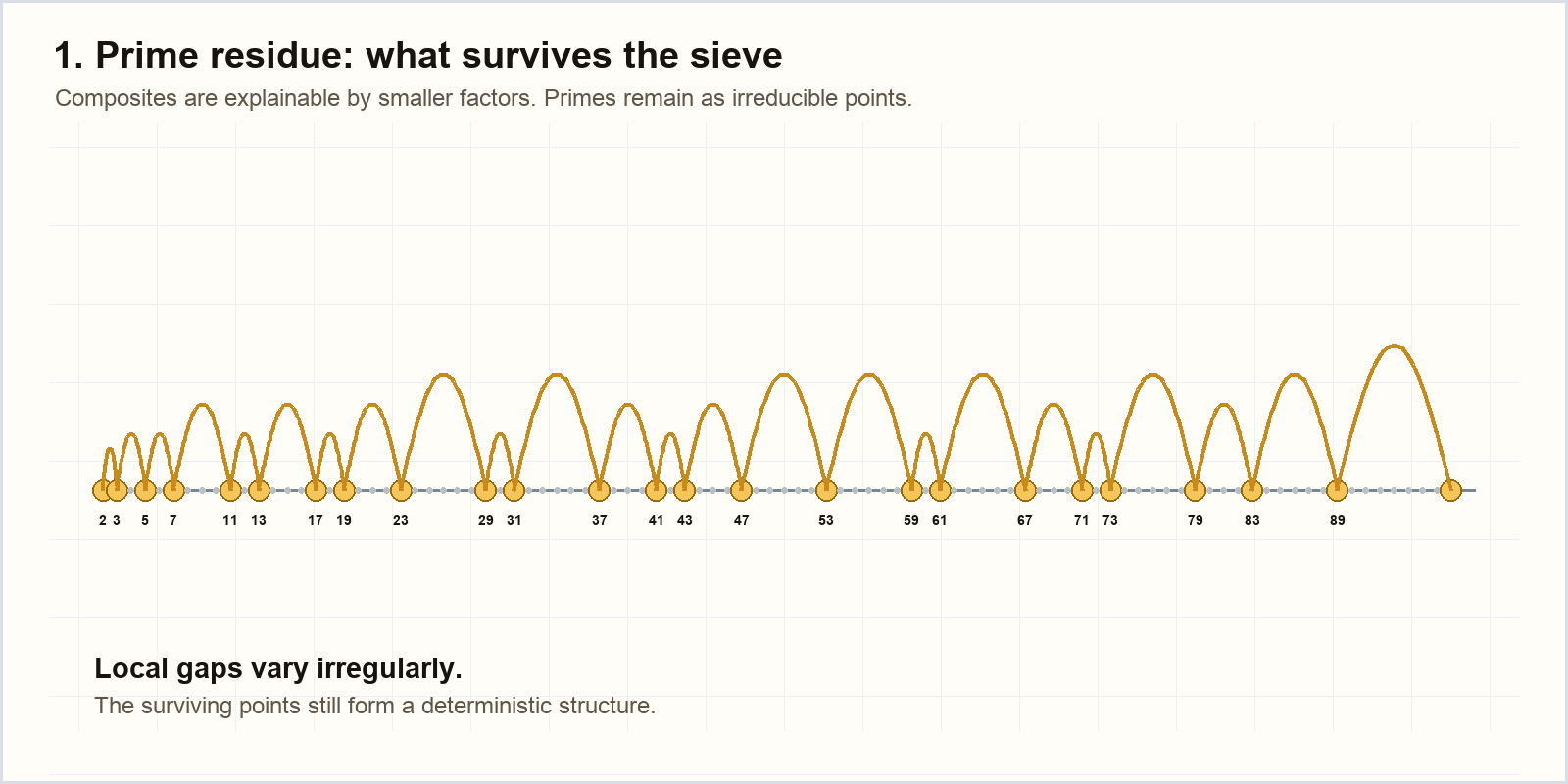
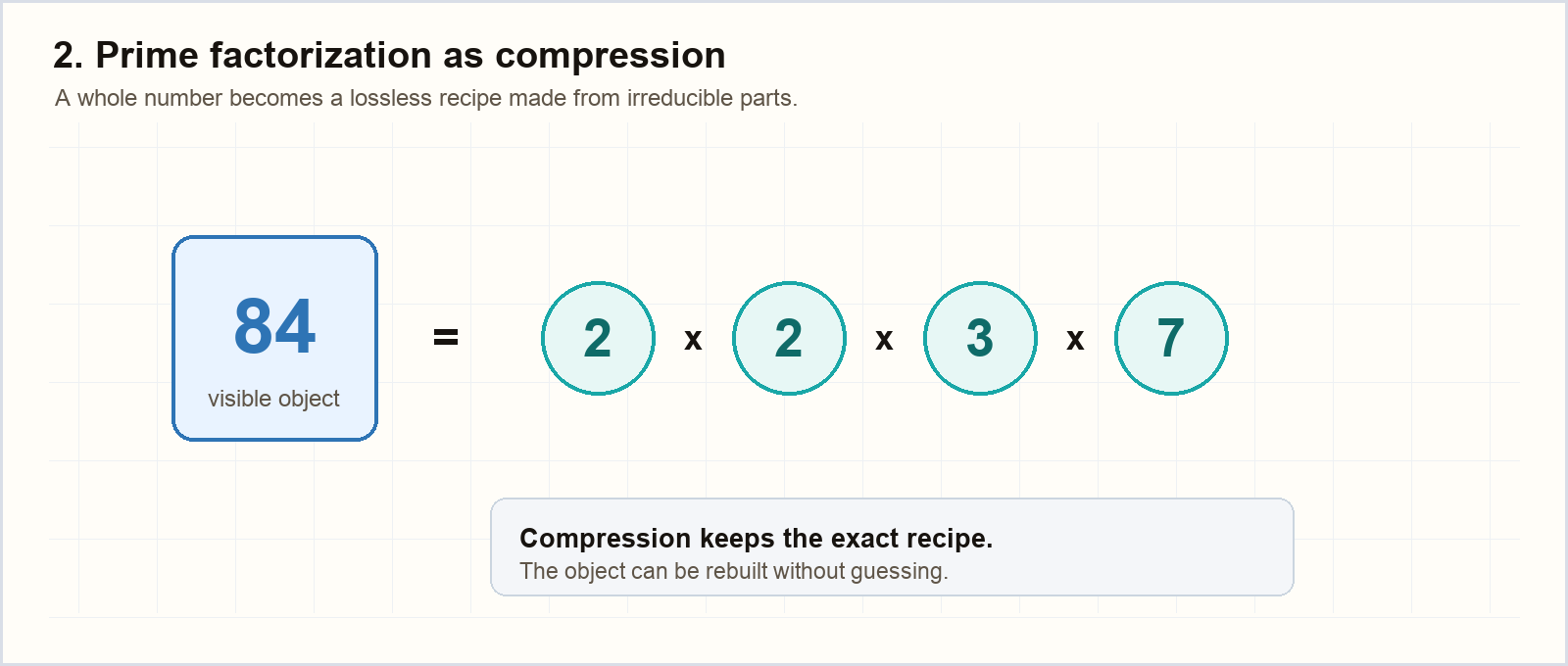
This is the ancient Sieve of Eratosthenes, but it already contains the philosophical hook. A prime is not merely a number that passed a test. A prime is a number that cannot be compressed multiplicatively into smaller whole-number components.
That word, compressed, is doing work. Every integer greater than 1 has a unique prime factorization. In other words, every whole number has one exact prime recipe.
Primes Thin Out Predictably, But Jitter Locally
As numbers grow, primes become rarer. Around a large number , the rough density of primes is about . Equivalently, the number of primes below is approximately . This is the Prime Number Theorem.
For a nontechnical reader, the Prime Number Theorem says something surprisingly human: from far away, primes have weather. You cannot predict the exact next raindrop, but you can describe the climate.
THE PARADOX Primes are deterministic enough to have a global law, but irregular enough that the local details still look wild.
That paradox becomes concrete when humans try to find record primes. In October 2024, the Great Internet Mersenne Prime Search announced the largest known prime: . Written out in base 10, it has digits. It was found by Luke Durant through a GPU-based cloud search and verified by independent checks.
This is the computational drama of primes. They are easy to define, but hard to discover at scale. Knowing the global climate of primes does not let you cheaply point to the next record prime. You still need clever algorithms, distributed search, error checking, specialized hardware, and independent verification.
That is why primes matter beyond number theory. They force computation to practice the same discipline that serious simulation needs: searching enormous spaces, detecting rare structure, avoiding false positives, and preserving global constraints without brute-forcing every local possibility.
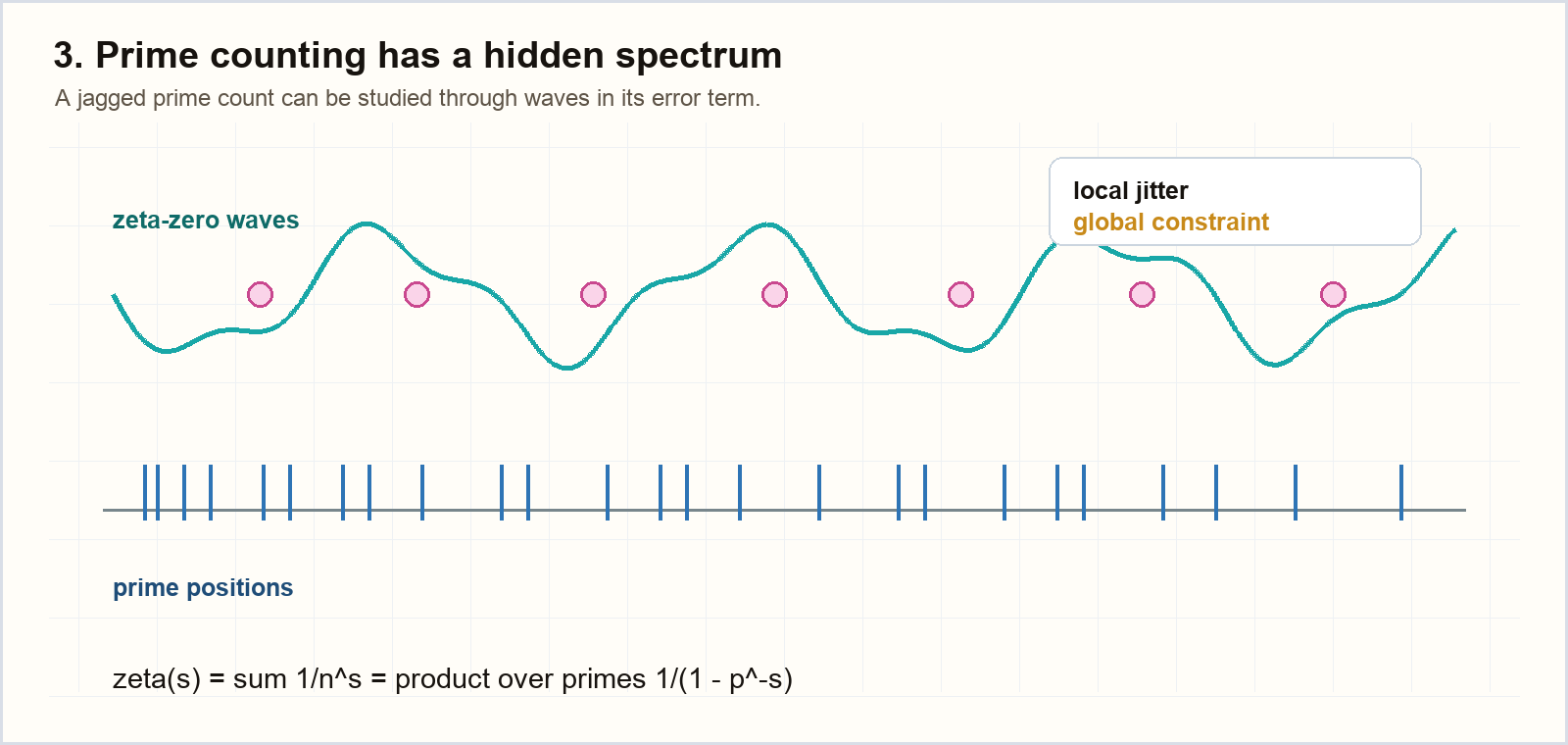
That local wildness is where the story becomes modern. The Prime Number Theorem gives the smooth trend. But the real question is the error: how far does the actual prime count wander away from the smooth approximation? How disciplined is the jitter?
In 1859, Bernhard Riemann found that this jitter is connected to the zeros of a complex function now called the Riemann zeta function. The zeta function can be written as a sum over all positive integers, but Euler had already shown that it can also be written as a product over primes:
That identity is one of the great compression moments in mathematics. The infinite world of all integers and the hidden world of primes are two faces of the same object.
Riemann's Shock: Prime Counting Has a Spectrum
The Riemann Hypothesis says that every nontrivial zero of the zeta function lies on a vertical line whose real part is 1/2. That sounds technical because it is technical. But the intuition is accessible: if the zeros all sit on the critical line, then the error in prime counting is as controlled as it can reasonably be.
This is not just a puzzle about a strange function. It is a statement about the architecture of arithmetic noise. It asks whether the apparent randomness of primes is secretly constrained by a hidden spectral order.
A spectrum is a list of frequencies or energy levels. A bell has a spectrum. An atom has a spectrum. A vibrating string has a spectrum. Riemann's discovery suggests that prime-counting error also has something spectrum-like behind it.
This is the first major turn in the story. The primes live on the number line, but the deepest information about their distribution appears to live somewhere else: in the geometry of complex zeros.
The Physics Connection: Zeta Zeros Behave Like Quantum Chaos
In the 1970s, Hugh Montgomery studied correlations between zeta zeros. Freeman Dyson recognized the same mathematics in random matrix theory, a framework physicists had used to model complicated energy spectra in heavy atomic nuclei. Later, Andrew Odlyzko computed enormous numbers of zeta zeros and found striking numerical agreement with the random-matrix predictions.
The careful claim is beautiful enough. The nontrivial zeta zeros appear to share local spacing statistics with the energy levels of certain chaotic quantum systems.
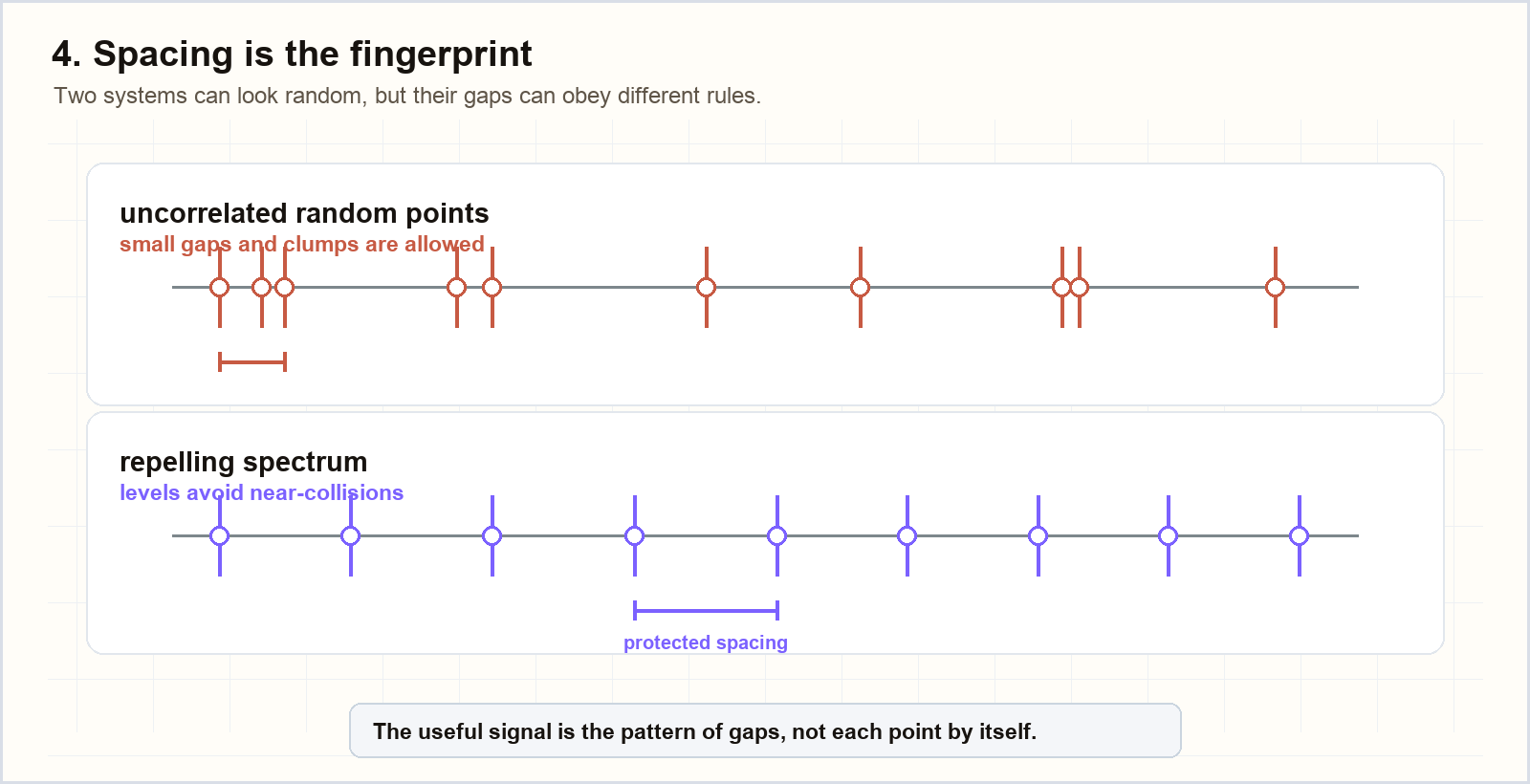
This does not mean uranium nuclei are using primes. It means primes and chaotic quantum systems appear to share a spectral grammar. The shared object is not a literal mechanism; it is a statistical structure.
The research frontier is the Hilbert-Polya idea: perhaps there exists a self-adjoint operator whose eigenvalues are the imaginary parts of the zeta zeros. If such an operator were found, it could provide a path toward the Riemann Hypothesis, because self-adjoint operators have real eigenvalues.
For a reader thinking about simulation, the interesting part is not only the Riemann Hypothesis. It is the recurring pattern: complex systems often reveal themselves through spectra. To simulate a system well, you do not only need its visible states. You need the hidden frequencies that constrain how those states can vary.
The Simulation Lesson: Preserve Structure, Not Every Detail
The practical lesson is not that prime theory gives us a magic shortcut for simulating the universe. The lesson is more useful: local unpredictability and global order can come from the same deterministic system.
A naive simulation tries to copy appearances. A serious simulation tries to preserve invariants. It asks what cannot change without the system ceasing to be itself.
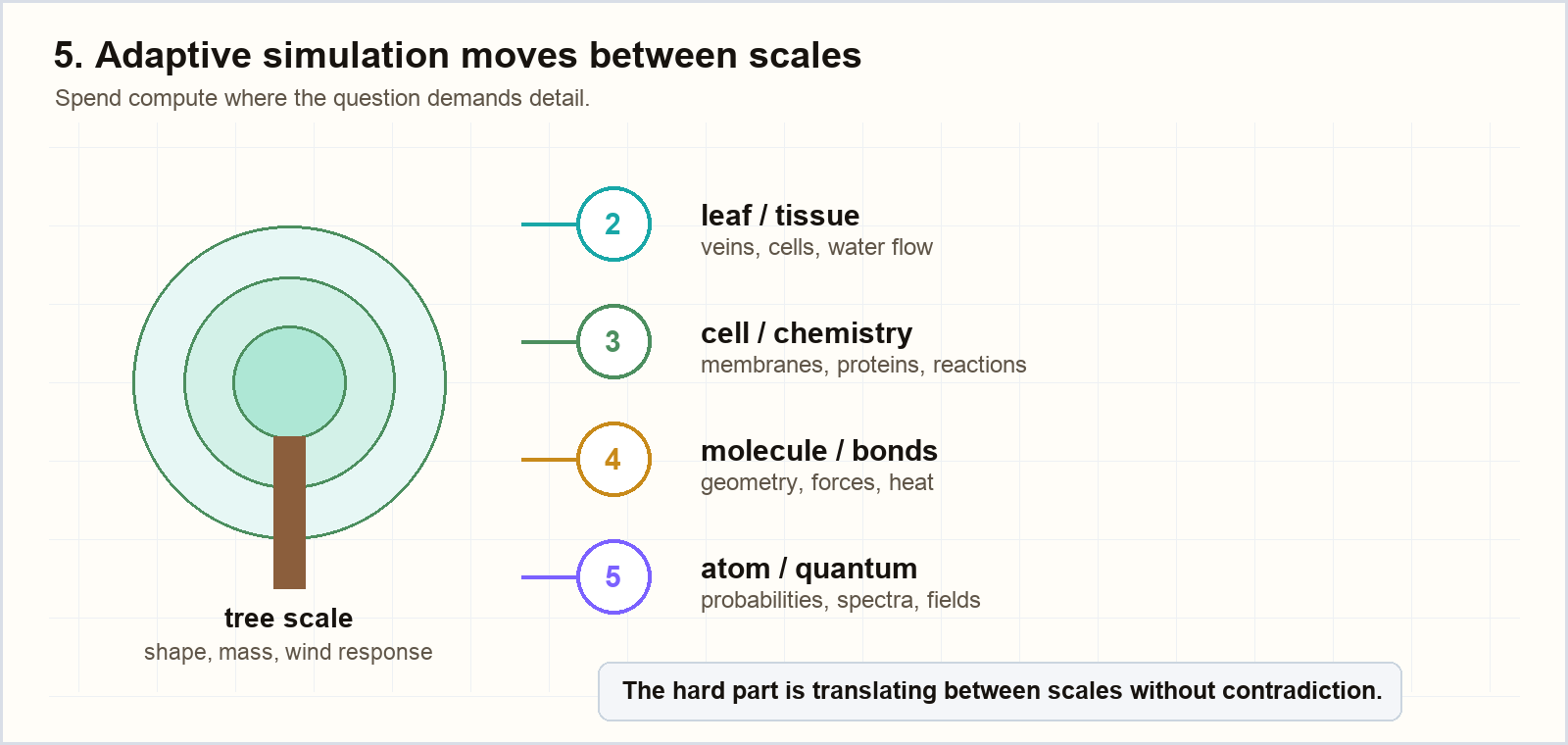
Imagine simulating a forest in the wind. A brute-force model tries to predict the exact motion of every leaf. That is expensive, fragile, and often unnecessary. A better model learns the variables that matter: wind, gravity, branch elasticity, turbulence, moisture, and tree structure. It does not need the exact pixel-level position of every leaf at every moment to understand the forest.
This does not mean the leaf-level details are fake. It means they belong to a different resolution. If we knew the exact state of every atom in a tree, the tree's behavior would be contained in that description in principle. But in practice, a simulator has to climb through layers: atoms become molecules, molecules become cells, cells become tissues, tissues become branches, and branches become an organism moving through wind, light, heat, and gravity. The hard problem is not choosing atoms or forests. The hard problem is moving between scales without breaking the pattern.
Prime numbers offer the mathematical version of that idea. The exact next prime gap can be locally hard to anticipate, but the primes are not pure noise. Across large scales, their density and error terms obey deep constraints. They show how a system can produce local irregularity without losing global coherence.
Primes teach three invariants that matter far beyond number theory:
- Irreducibility: complex objects may be built from components that cannot be decomposed further within the system.
- Structured unpredictability: deterministic rules can generate behavior that looks random locally while remaining globally constrained.
- Spectral control: the deepest regularities of a system may appear not in its surface events, but in the frequencies, gaps, and correlations behind those events.
That is why primes belong in a conversation about reality simulation. Not because they literally dictate every physical process, but because they reveal the kind of mathematical problem simulation has to solve: how to preserve global structure while allowing rich local variation.
SIMULATION THESIS Better simulations may come from learning hidden constraints, not from spending compute on every local fluctuation.
JEPA and the AI Version of the Same Lesson
Yann LeCun's Joint Embedding Predictive Architecture, or JEPA, gives a modern AI analogy for the same principle. JEPA-style systems do not try to predict every raw pixel or token. They predict in a learned representation space, where irrelevant surface detail can be compressed away.
This matters because the world contains details that are real but not always useful. A video model that tries to predict the exact movement of every leaf, sparkle, shadow, or texture spends capacity on details that may not help it reason or plan. A latent world model tries to preserve the abstract structure that matters while ignoring unpredictable low-level noise.
That is the bridge to primes. Prime gaps look locally irregular, but the global structure is constrained. JEPA makes a similar bet in AI: do not obsess over every local detail; learn the representation where the stable structure lives.
The connection is not that JEPA uses primes. The connection is deeper: both stories reward the same instinct. Stop worshipping surface detail. Find the structure that survives underneath it.
Timing and Biology: Rhythm Without Collision
There are real places where prime-like timing matters. Periodical cicadas famously emerge in 13- or 17-year cycles. One major evolutionary hypothesis is that prime-numbered life cycles reduce synchronization with predators, parasites, or competing broods that operate on shorter periodic schedules.
The point is not that biology is secretly doing analytic number theory. The point is that prime or relatively prime intervals are useful when synchronization is dangerous. A 12-year cycle collides often with 2-, 3-, 4-, and 6-year rhythms. A 13-year cycle collides less often.
The cicada story matters because it makes the abstraction physical. Pattern is useful, but repeated pattern can become a trap. Systems that compute, evolve, or communicate have to manage collisions between rhythm and surprise.
The Big Question Researchers Are Still Pushing On
The deepest question is not whether primes are magic. They are not. The deepest question is why a simple deterministic object can generate so much structured unpredictability.
That question reaches into several active frontiers:
- Can the Riemann Hypothesis be turned into a spectral theorem?
- Why do random matrix statistics appear across unrelated complex systems?
- Can number-theoretic structures improve pseudorandomness, sampling, hashing, cryptography, or simulation methods?
- What can AI learn from systems where local detail is hard to predict but global structure is stable?
- What separates a real hidden law from a beautiful analogy?
This is where primes become philosophically powerful. They show that randomness is not one thing. Some randomness is ignorance. Some randomness is noise. Some randomness is deterministic complexity seen from the wrong angle.
If we want to simulate reality, we need to know which kind we are looking at.
The Oldest Door Into Structured Chaos
Prime numbers are not the universe's source code. They are something more useful for science: a clean, ancient, brutally precise test of our ability to understand structure inside apparent randomness.
They begin as school arithmetic and end at the edge of quantum chaos. They begin as indivisible numbers and end as spectral questions. They begin with a child crossing composites out of a grid and end with researchers asking whether the deepest unsolved problem in mathematics is secretly an operator waiting to be found.
That is why primes matter for reality simulation. A digital universe will not be convincing because it draws atoms beautifully. It will be convincing because it preserves the hidden constraints that make complexity coherent.
Primes are where humanity first learned that the simplest rules can hide the deepest chaos.
And we still do not fully understand them.
Sources and Further Reading
- Clay Mathematics Institute, Problems of the Millennium: The Riemann Hypothesis
- Clay Mathematics Institute, Riemann's 1859 Manuscript
- GIMPS, Largest Known Prime Number: 2^136,279,841 - 1
- Bohigas, Giannoni, and Schmit, Characterization of Chaotic Quantum Spectra
- Scholarpedia, Bohigas-Giannoni-Schmit conjecture
- Odlyzko, The 10^20-th zero of the Riemann zeta function and 70 million of its neighbors
- Meta AI, I-JEPA: The first AI model based on Yann LeCun's vision for more human-like AI
- Meta AI, V-JEPA: The next step toward advanced machine intelligence
- LeCun, A Path Towards Autonomous Machine Intelligence
- PubMed, Selection for prime-number intervals in a numerical model of periodical cicada evolution
- Terence Tao, The Riemann zeta function and the prime number theorem